Description
Shubunkin Goldfish (Carassius auratus)
Overview
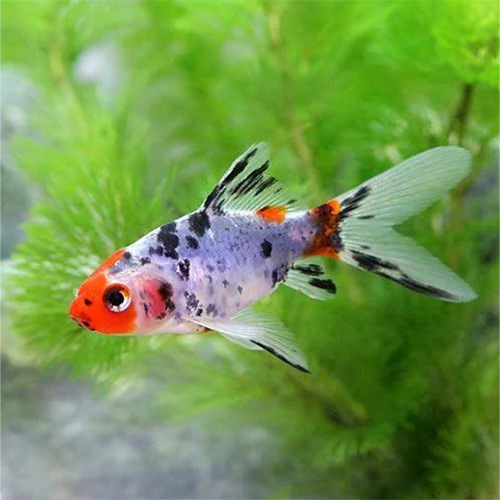
The Shubunkin Goldfish (Carassius auratus) is a hardy, active, and strikingly colorful single-tailed fancy goldfish created in Japan. It is prized for its calico coloration and sleek, streamlined build.
- Appearance: Features a streamlined, slender body (similar to the common goldfish) covered in transparent and nacreous scales, creating a distinctive calico pattern. Their coloration is a mottled mix of blue, lavender, red, orange, brown, and black, overlaid with dark speckles. They possess long, flowing caudal (tail) fins, often with slightly extended fork tips.
- Size: Grows to approximately 20 to 30 cm (8 to 12 inches) in length as adults.
- Lifespan: Exceptionally hardy and long-lived, commonly surviving 10 to 15 years (or even up to 20 years) when given proper care.
Care Requirements
- Aquarium Size: Because of their large adult size, rapid swimming speeds, and high activity levels, a minimum aquarium size of 200 to 250 liters (approx. 50 to 65 gallons) is recommended for a pair or small group. (Note: Due to their hardiness and size, they are also exceptionally well-suited for outdoor garden ponds).
- Water Parameters:
- Temperature: 10°C to 22°C (50°F to 72°F). They are a cold-water species and thrive best in unheated indoor tanks or outdoor ponds; they do not enjoy sustained tropical temperatures.
- pH: 6.5 to 8.0 (thrives best in neutral to slightly alkaline water)
- General Hardness (GH): 10 to 20°H
- Filtration & Flow: Heavy-duty filtration is essential to manage their large waste output. Unlike slow-moving fancy goldfish, Shubunkins are powerful, fast swimmers and appreciate moderate water movement and robust current.
Maintenance
- Aquascaping: Because they are active swimmers, provide plenty of open swimming space in the center of the tank. Use smooth river rocks, sturdy driftwood, and robust live plants (Anubias or Java Fern) if desired—though keep in mind that active Shubunkins may occasionally uproot soft vegetation. Avoid sharp decorations that could tear their flowing fins.
- Water Quality & Changes: Perform routine partial water changes (25% to 30% weekly) to maintain low nitrate levels and high water quality. A secure, tight-fitting aquarium lid is mandatory, as their powerful swimming and darting habits make them strong jumpers.
Diet
- Nature: Omnivorous, active, and enthusiastic surface and mid-water feeders with a healthy appetite.
- Staple Diet: High-quality sinking or floating goldfish pellets, flakes, or gel foods.
- Vegetable Matter: They require a fiber-rich diet to maintain good digestive health. Supplement their daily diet regularly with blanched vegetables (such as shelled peas, zucchini, spinach, or cucumber) and occasional treats of daphnia or brine shrimp.
Behaviour and Compatibility
- Temperament: Highly active, alert, fast-swimming, and peaceful. They spend most of their time actively cruising the water column.
- Social Needs: They are social schooling fish that prefer the company of their own kind. Keep them in small groups in a spacious tank or pond.
- Tank Mates: Ideal for communities with other fast, single-tailed goldfish varieties (such as Comets or Common Goldfish). Avoid housing them with slow-moving, round-bodied fancy goldfish (like Orandas, Ranchus, or Fantails) because the speedy Shubunkins will aggressively outcompete them for food and can accidentally stress them out. Never keep them with tropical fish.
Breeding Behaviour
- Spawning Setup: Spawning usually occurs in the spring, triggered by rising water temperatures. In an aquarium setting, it requires a large breeding tank with cool-water triggers, reliable aeration, and dense spawning mops or fine-leaved plants.
- The Process: Mature males develop tiny white tubercles (breeding stars) on their gill covers and pectoral fins. Males will enthusiastically chase and nudge females around the tank, prompting her to release thousands of sticky, clear eggs over the vegetation, which the males immediately fertilize.
- Raising Fry: Adult Shubunkins will eagerly eat their eggs and fry. If breeding is successful, parents or egg-laden mops should be separated immediately. The tiny fry hatch in 4 to 7 days, hanging vertically before becoming free-swimming, at which point they require microscopic infusoria or liquid fry food followed by newly hatched brine shrimp.
Picture for illustrative purposes only. Either come in store to view available stock or request pictures to be sent to you.
Please Note: Due to variations within species resulting from age, region, sex, etc., the actual livestock may not look identical to the image. Approximate size range may also vary between individual specimens.