Description
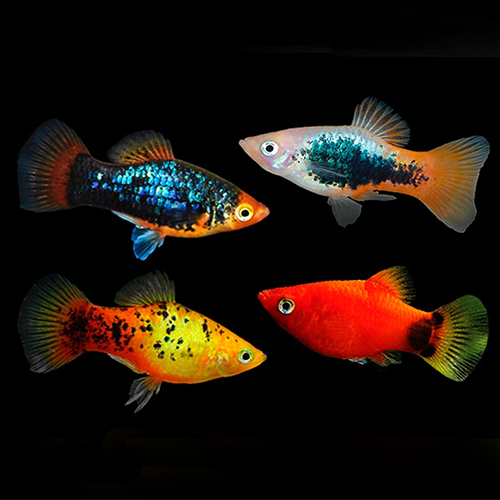
Assorted Platy (Xiphophorus maculatus)
Overview
The Platy (Xiphophorus maculatus) is a peaceful, colourful, and hardy freshwater livebearer native to Central America. Known for its compact, stout body and wide range of captive-bred colours including Mickey Mouse, Sunburst, Wagtail, and Coral. Yhis active fish is one of the best choices for community aquariums.
Care Requirements
Tank Size:
Minimum 60-75 liters aquarium comfortably houses a small group..
Care Level:
Easy, making them ideal for beginners and seasoned aquarists alike
Water Parameters:
- Temperature: 20–26°C
- pH: 7.0–8.0
- Hardness: 10–25 dGH
- Filtration & Flow. Provide gentle to moderate filtration. In the wild, they inhabit slow-moving streams, springs, and canals, so avoid overly strong currents that exhaust them.
Aquarium Setup:
- Planted Cover. Fill the background and sides with hardy plants such as Vallisneria, Hygrophila, Java fern, or Anubias. Dense foliage reduces stress and gives females shelter from persistent males.
- Open Swimming Lane. Leave the front center of the aquarium open for active grazing and social interaction.
- Substrate & Decor. Any smooth aquarium gravel or sand works well, paired with driftwood or smooth river stones that naturally grow a light layer of biofilm for grazing.
- Secure Lid. Keep a fitted cover on the tank to prevent accidental jumps and slow down water evaporation.
Maintenance
- Water Changes. Perform a 25% weekly water change using dechlorinated water matched to the tank’s temperature and hardness.
- Water Testing. Monitor ammonia and nitrite (kept at 0 ppm) alongside nitrates (kept below 20–30 ppm). Check pH and carbonate hardness (KH) if your local water is soft, adding crushed coral to the filter if needed.
- Filter Upkeep. Rinse mechanical filter sponges in removed aquarium water every 2 to 4 weeks to maintain steady flow without disturbing beneficial bacteria.
Diet
- Omnivorous Grazer. Platies naturally graze on algae, soft plant matter, and tiny aquatic invertebrates throughout the day.
- Vegetable-Rich Staples. Feed a quality spirulina-based flake or micro-pellet as their daily base, supplemented with blanched zucchini, spinach, or shelled peas to support digestion.
- Protein Treats. Offer frozen or live brine shrimp, daphnia, or bloodworms once or twice a week for vibrant colour and conditioning.
Behaviour and Compatibility
- Social Ratios. Platies are peaceful and social, doing best in groups of five or more. Keep a ratio of 2 to 3 females per male so males do not exhaust individual females with constant courtship.
- Ideal Tankmates. They pair well with peaceful community species that enjoy similar neutral-to-alkaline water, such as Guppies, Mollies, Corydoras catfish, Harlequin Rasboras, Zebra Danios, and Cherry Barbs.
- Tankmates to Avoid. Avoid large, aggressive predators that can swallow them, as well as Swordtails (Xiphophorus helleri) if you want to prevent cross-breeding and hybridisation.
Breeding Behaviour
- Sexual Dimorphism. Mature males have a slender body and a pointed, rod-shaped anal fin called a gonopodium. Females are noticeably rounder and deeper-bodied with a fan-shaped anal fin.
- Livebearing Reproduction. Platies give birth to live, free-swimming young after a gestation period of 24 to 30 days. A single female can produce 20 to 80 fry per brood and stores sperm to deliver multiple broods over several months.
- Protecting Fry. Adults make no effort to care for their young and will eat newborn fry. Floating plants like hornwort, water sprite, or Java moss provide natural hiding places so the hardiest fry survive in a community tank.
Please Note: Due to variations within species resulting from age, region, sex, etc., the actual livestock may not look identical to the image. Approximate size range may also vary between individual specimens.


