Description
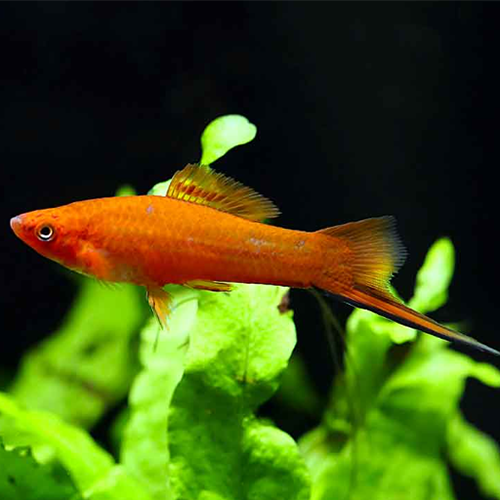
Assorted Swordtail (Xiphophorus helleri)
Overview
The Swordtail (Xiphophorus helleri) is a vibrant, active freshwater livebearer native to Central and North America. Famous for the elongated, sword-like lower caudal fin extension found on mature males, this hardy, colorful species is a staple in community aquariums.
Care Requirements
Tank Size:
Minimum 110-130 liters aquarium is recommended to give these active swimmers plenty of horizontal room.
Care Level:
Easy, making them well-suited for beginners as long as they have adequate swimming space.
Water Parameters:
- Temperature: 22–28°C
- pH: 7.0–8.0
- Hardness: 10–25 dGH
- Filtration & Flow. They naturally inhabit briskly flowing rivers and streams, so provide good filtration and moderate water movement alongside well-oxygenated water.
Aquarium Setup:
- Tight-Fitting Lid. Swordtails are notorious jumpers when startled or chased, so always cover the aquarium completely.
- Planted Zones. Arrange dense clusters of hardy stem plants like Vallisneria, Hygrophila, Java fern, or hornwort along the back and sides to create visual barriers and hiding spots for females and fry.
- Open Foreground. Leave the front center of the tank open so they can cruise freely across the length of the aquarium.
- Substrate & Decor. Any smooth gravel or sand works well, paired with smooth river stones and driftwood.
Maintenance
- Water Changes. Perform a 25% to 30% weekly water change using dechlorinated water matched to the tank’s temperature and hardness.
- Parameter Checks. Test pH and carbonate hardness (KH) regularly if your local tap water is naturally soft, adding crushed coral or mineral buffers if needed to prevent pH crashes.
- Filter Care. Rinse mechanical filter media in removed aquarium water every 2 to 4 weeks to maintain strong water circulation.
Diet
- Omnivorous Grazer. In the wild, they feed on algae, plant matter, insects, and small crustaceans.
- Staple Foods. Feed a high-quality flake or micro-pellet rich in vegetable matter, such as spirulina, alongside blanched spinach, zucchini, or peas.
- Protein Boosts. Supplement their diet two to three times a week with frozen or live brine shrimp, daphnia, or bloodworms to enhance coloration and support breeding health.
Behaviour and Compatibility
- Male Territory & Ratios. Males can become territorial and harass each other or constantly chase females. Keep either a single male with 2 to 3 females per male, or maintain a larger group of 6+ individuals so aggression is dispersed.
- Peaceful Community Tankmates. They pair well with robust, active community fish that enjoy similar water parameters, such as Platies, Mollies, larger Tetras, Rasboras, Danios, Rainbowfish, and Corydoras catfish.
- Tankmates to Avoid. Avoid housing them with slow, long-finned fish like Betta splendens or fancy Guppies, as Swordtails may nip trailing fins, and avoid hybridizing them with Platies (Xiphophorus maculatus) if you want to keep bloodlines pure.
Breeding Behaviour
- Sexual Dimorphism. Mature males develop the signature sword tail extension and a modified anal fin called a gonopodium. Females lack the sword, have a rounded fan-shaped anal fin, and grow noticeably larger and fuller-bodied.
- Prolific Livebearers. Swordtails bear live, free-swimming young rather than laying eggs. After a gestation period of roughly 28 to 35 days, a female can give birth to 20 to 100 fry per brood and can store sperm to produce multiple broods from a single mating.
- Fry Survival. Adults will readily eat newborn fry. Provide dense floating plants like Java moss or hornwort, or move pregnant females into a separate breeding tank just before delivery, removing the mother once birthing finishes.
Please Note: Due to variations within species resulting from age, region, sex, etc., the actual livestock may not look identical to the image. Approximate size range may also vary between individual specimens.