Description
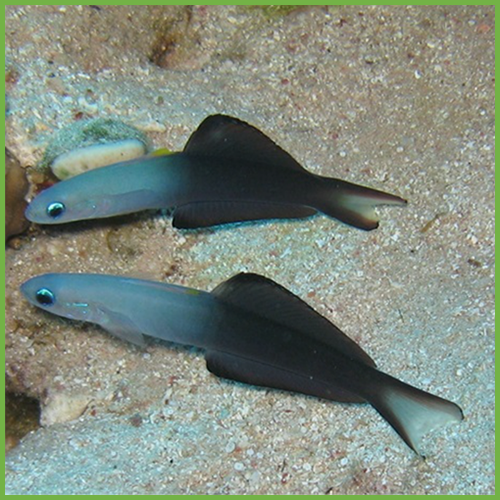
Blackfin Dartfish (Ptereleotris evides)
Overview
The Ptereleotris evides, commonly known as the Blackfin Dartfish or Scissortail Goby, is a graceful, peaceful species that adds movement and charm to a marine aquarium. They are well-regarded for their distinctive trailing caudal fin and their habit of hovering in the water column. Grows to 6–8 cm. Best kept by hobbyists who can provide stable reef/tank conditions and secure lid (jump risk).
- Temperament: Extremely peaceful and timid.
- Size: Typically grows to 6–8 cm (2.5–3.5 inches).
- Key Trait: They are excellent jumpers and require a secure, tight-fitting lid at all times.
- Behavior: They are naturally schooling or social fish that are happiest when kept in pairs or small groups.
Care Requirements
- Tank size: 120+ litres for single/pair; 200+ litres recommended for small group or mixed community.
- Temperature: 24–27°C
- Salinity/SG: 1.020–1.025
- pH: 8.1–8.4
- Alkalinity: 8–12 dKH
- Ammonia/ Nitrite: 0 ppm; Nitrate < 20 ppm
- Substrate & decor: fine sand bed, live rock with caves/overhangs for perching and quick retreats
- Lighting: moderate (they do not require intense light)
Maintenance
- Weekly to biweekly water changes (10–20%) depending on bioload.
- Maintain strong, steady water flow with some calm zones for hovering.
- Monitor parameters frequently; dartfishes are sensitive to sudden changes.
- Keep a tight-fitting lid to prevent jumping.
Diet
- Carnivorous/planktivorous: accept meaty foods.
- Staples: frozen mysis, brine shrimp, copepods, finely chopped seafood, enriched rotifers/copepods for juveniles.
- Supplement: high-quality marine pellets/flakes, but prefer frozen/live items.
- Feeding schedule: 1–2 times daily; small, frequent feeds. Offer microfood or target-feed if shy.
Behavior and Compatibility
- Temperament: peaceful, timid. Often hovers above substrate or perches on rock; darts to hiding spots when startled.
- Social: can be kept singly, in pairs, or small groups; conspecifics may establish hierarchy—watch for minor chasing but generally non-aggressive.
- Tankmates: compatible with peaceful reef species (gobies, blennies, small wrasses, clownfish, gobies).
- Avoid large, predatory, or highly aggressive fish that may bully or eat them.
- Reef-safety: generally reef safe (won’t bother corals), but will eat very small ornamental invertebrates (tiny shrimp/larvae).
Reproduction
- Typically forms pairs; spawning involves courtship and release of pelagic eggs/larvae.
- Breeding in captivity is challenging due to planktonic larval stage and specific feeding needs (rotifers/infusoria then copepod/micro diet).
- If attempting: provide pair, stable tank, plentiful live planktonic food cultures, and isolation for fry capture.
Tips
- Jump Risk: This is the most critical factor; always keep the tank covered.
- Acclimation: Always quarantine new specimens to monitor health and feeding behavior before introducing them to the main display.
- Environment: Providing a secure, stress-free environment with plenty of hiding spots is the best way to encourage them to display their natural, active behavior.
Picture for illustrative purposes only. Either come in store to view available stock or request pictures to be sent to you.
Please Note: Due to variations within species resulting from age, region, sex, etc., the actual livestock may not look identical to the image. Approximate size range may also vary between individual specimens.