Description
Blue Lacustrus Rainbow (Melanotaenia lacustrus)
Overview
The Blue Lacustrus Rainbowfish (Melanotaenia lacustris), commonly known as the Lake Kutubu Rainbowfish or Turquoise Rainbowfish, is a striking freshwater fish endemic to Lake Kutubu and its surrounding outlets in the Southern Highlands of Papua New Guinea.
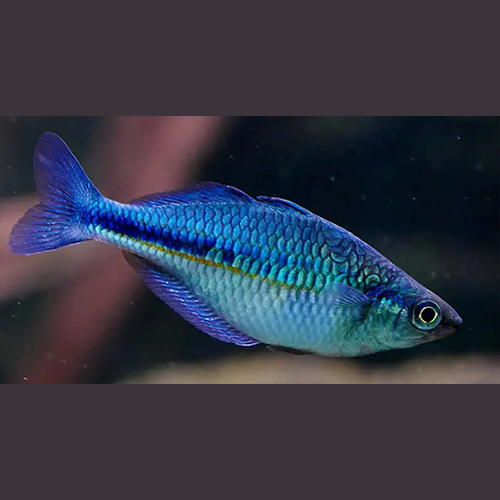
- Appearance: Adult males develop a deep, high-backed body shape and brilliant metallic hues ranging from cobalt blue and steel blue to turquoise on the upper half, contrasted by a silvery-white belly. Mature males also display a distinct orange or reddish stripe on their forehead when in breeding condition. Females remain slimmer, smaller, and more subtly colored.
- Size: Grows to approximately 10 to 12 cm (4 to 5 inches) in length.
- Lifespan: Typically 5 to 8 years under optimal care conditions.
Care Requirements
- Aquarium Size: Because they are active, fast-swimming shoaling fish, they require a long tank. A minimum of 110 to 180 liters (approx. 4 feet or 120 cm in length) is recommended to provide adequate swimming lanes.
- Water Parameters:
- Temperature: 20°C to 27°C
- pH: 7.0 to 8.5 (thrives best in slightly hard, alkaline water and does poorly in soft, acidic conditions)
- General Hardness (GH): 10 to 20°H (100–350 ppm)
- Filtration & Flow: Strong biological filtration and good oxygenation are essential, but keep direct water current to a minimum or moderate level to mimic their native still-to-slow lake environment.
Maintenance
- Aquascaping: Recreate a natural biotope by combining dense plantings along the sides and back (such as fine-leaved plants or Java moss) with plenty of open swimming space in the middle and upper water columns. Submerged driftwood or roots can also be added.
- Water Quality & Changes: Perform regular partial water changes (20% to 30% monthly or bi-weekly depending on stocking density) to keep nitrates low. A tight-fitting aquarium lid is strongly advised, as these active swimmers can occasionally jump.
Diet
- Nature: Omnivorous and unfussy, readily accepting a wide variety of foods.
- Staple Diet: High-quality flake food, spirulina-rich flakes, or small sinking/floating granules.
- Enhancing Color: To bring out their signature metallic blues, supplement their diet regularly with live or frozen foods such as Artemia (brine shrimp), daphnia, cyclops, mysis shrimp, and bloodworms (in moderation). Incorporating some vegetable matter or spirulina is also beneficial.
Behaviour and Compatibility
- Temperament: Exceptionally peaceful, active, and social. They occupy the middle and upper levels of the water column.
- Shoaling Needs: This is a strictly gregarious species that must be kept in a group of at least 6 to 8 individuals (preferably with a higher ratio of females). Keeping them isolated or in too-small groups leads to severe stress, fading colors, and susceptibility to disease.
- Tank Mates: Ideal for community setups with other similarly sized, peaceful fish such as other rainbowfish species, peaceful barbs, robust tetras, danios, freshwater gobies, and bottom-dwelling catfish like Corydoras. Avoid housing them with extremely slow-moving, tiny, or long-finned fish, as their rapid, darting movements can inadvertently stress timid tank mates.
Breeding Behaviour
- Spawning Setup: Set up a separate breeding tank (around 30 inches long) filled with mature water, gentle filtration (such as a sponge filter), and plenty of fine-leaved plants or nylon spawning mops to catch adhesive eggs.
- Conditioning: Condition a healthy pair or a group with frequent feedings of live and frozen foods. A slight bump in temperature can help trigger spawning.
- The Process: As “continuous spawners,” males will display their intense breeding colors and forehead stripe, driving females over the vegetation where small batches of eggs are fertilized and scattered daily over several weeks.
- Raising Fry: Adults will eat their own eggs, so it is best to check spawning mops regularly and transfer eggs to a separate rearing tank. The tiny fry hatch in roughly 7 to 12 days and initially require microscopic foods like infusoria or vinegar eels before graduating to newly hatched brine shrimp.
Picture for illustrative purposes only. Either come in store to view available stock or request pictures to be sent to you.
Please Note: Due to variations within species resulting from age, region, sex, etc., the actual livestock may not look identical to the image. Approximate size range may also vary between individual specimens.