Description
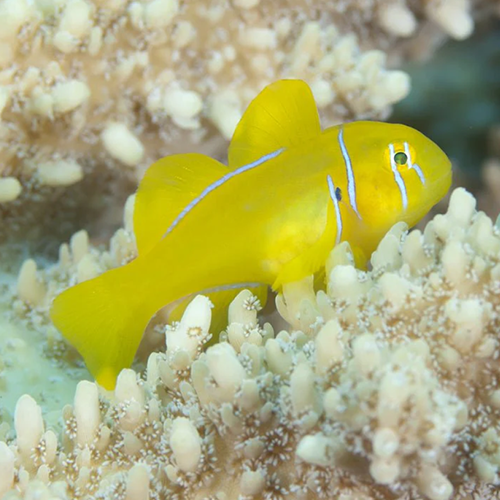
Citron Goby (Gobiodon citrinus) Blue-streaked Goby
Overview
Gobiodon citrinus, commonly known as the Citron Goby, Blue-streal Goby or Lemon Coral Goby, is a small, charismatic marine fish prized for its personality and vibrant colors. Because they naturally associate with coral reefs, they have specific environmental needs to thrive in captivity.
- Temperament: Peaceful; can be shy.
- Size: Grows to approximately 6.5 cm.
- Unique Feature: Produces a toxic mucus as a natural defense mechanism against predators.
- Reef Safety: Generally reef-safe, though they may nip at the polyps of host corals.
Care Requirements
- Tank Size: Minimum 40 litres for a single fish or pair; 120 litres is recommended to provide ample space for coral and territories.
- Temperature: 22–26°C.
- Salinity: 1.020–1.025 SG.
- pH: 8.1–8.4.
- Environment: They require live rock and, ideally, Small Polyp Stony (SPS) corals (such as Acropora) for perching and shelter. They lack a swim bladder and rely on their fused pelvic fins to “anchor” themselves to coral branches.
- Safety: A tight-fitting lid is mandatory, as they are capable of jumping. Ensure any intake tubes are covered to prevent them from being sucked in.
Maintenance
- Water Quality: Stable parameters are essential. Perform regular 10–25% water changes every 2–4 weeks.
- Filtration: Good biological filtration is necessary, and a protein skimmer is recommended for optimal water quality.
- Monitoring: Keep an eye on the health of your coral hosts, as these gobies may strip small areas of polyp tissue to lay their eggs.
Diet
- Type: Carnivore/Planktivore.
- Staples: In the wild, they consume plankton and small invertebrates. In the aquarium, offer high-quality frozen foods like Mysis shrimp, brine shrimp, cyclops, and finely chopped seafood.
- Feeding Habits: They are not active hunters and often wait for food to come to them. Because they are slow eaters, they may be outcompeted by faster fish; target feeding is often necessary.
- Acclimation: New specimens may be finicky. It is often helpful to start with live food to trigger a feeding response before transitioning them to frozen offerings.
Behavior and Compatibility
- Social: Peaceful toward other species, but can be territorial toward their own kind or similar-looking gobies in smaller tanks.
- Tankmates: Best kept with other small, peaceful, slow-moving fish. Avoid large, aggressive, or predatory fish that might harass or eat them.
- Note: Their toxic mucus provides them some protection, but they remain vulnerable to bullying.
Reproduction
- Gobiodon citrinus are protogynous hermaphrodites (capable of sex change). In a pair, the larger fish typically functions as the male.
- Breeding is possible in captivity but challenging. They lay demersal eggs, usually on a branch of coral they have cleared of polyps. Rearing the fry requires a dedicated setup with a steady supply of live micro-foods like rotifers.
Tips
- Quarantine: Always quarantine new arrivals to ensure they are eating and disease-free before adding them to your display tank.
- Avoid Emaciation: When purchasing, select fish that look well-fed and healthy; emaciated individuals are often difficult to rehabilitate.
- Coral Choice: While they prefer Acropora, they can adapt to other coral types. If you do not wish to keep corals, provide plenty of complex live rock for hiding and perching.
- Toxicity: Be aware that their protective mucus is toxic to some fish; while rarely an issue in a properly stocked tank, it is something to consider if you experience high stress or death in a confined space.
Picture for illustrative purposes only. Either come in store to view available stock or request pictures to be sent to you.
Please Note: Due to variations within species resulting from age, region, sex, etc., the actual livestock may not look identical to the image. Approximate size range may also vary between individual specimens.