Description
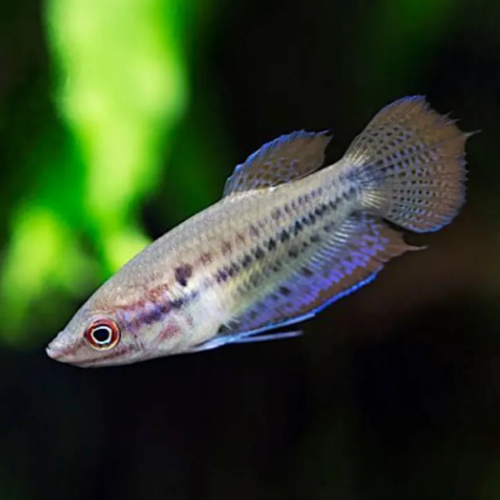
Croaking Gourami (Trichopsis vittata)
Overview
The Croaking Gourami (Trichopsis vittata), sometimes called the Pygmy Gourami or Banded Gourami, is a small, fascinating labyrinth fish native to Southeast Asia (including Thailand, Malaysia, Indonesia, and parts of the Greater Mekong basin).
- Appearance: Features an elongated, compressed body marked by several horizontal, iridescent turquoise and brownish stripes running along its flanks. Its fins are adorned with striking blue, green, and red highlights. One of its most unique features is its ability to produce audible clicking or “croaking” sounds, usually during courtship or territorial disputes, made by vibrating specialized pectoral fin tendons.
- Size: Grows to approximately 3.5 to 4 cm (1.5 inches) in length.
- Lifespan: Typically 3 to 5 years under proper care.
Care Requirements
- Aquarium Size: Because of their small adult size, a single pair or a small group can be comfortably housed in a nano aquarium starting at 40 to 50 liters (approx. 10 to 15 gallons).
- Water Parameters:
- Temperature: 22°C to 28°C
- pH: 6.0 to 7.5 (they prefer slightly acidic to neutral water)
- General Hardness (GH): 2 to 10°H (soft to moderately hard water)
- Filtration & Flow: Labyrinth fish possess a specialized organ that allows them to breathe atmospheric air, meaning they inhabit slow-moving or stagnant waters naturally. Keep filtration gentle so they are not buffeted by strong currents. A tight-fitting lid is essential to maintain a warm, humid layer of air above the water surface.
Maintenance
- Aquascaping: They thrive in a heavily planted aquarium that mimics a shallow, slow-moving stream or peat swamp. Use plenty of live plants (such as cryptocorynes, floating plants to diffuse overhead lighting, and Java moss), driftwood, and dried botanicals or Indian almond leaves to leach tannins, creating a natural darkwater look.
- Water Quality & Changes: Perform regular, small partial water changes (15% to 20% weekly) to keep organic waste low. Avoid sudden large water parameter swings.
Diet
- Nature: Micro-predators in the wild, feeding on tiny insects, insect larvae, and zooplankton.
- Staple Diet: High-quality micro-pellets, crushed flake food, or fine granular foods designed for nano fish.
- Enhancing Health & Color: Supplement their diet regularly with live or frozen foods such as baby brine shrimp, cyclops, daphnia, and micro-worms. Because of their small mouths, food size must be kept appropriately small.
Behaviour and Compatibility
- Temperament: Generally shy and peaceful, though males can display mild territorial behavior toward one another when establishing dominance (accompanied by their signature clicking sounds). They occupy the middle and upper levels of the water column.
- Social Needs: Can be kept as a single pair or in small groups. When kept in groups, providing plenty of visual barriers (plants and wood) helps minimize minor aggression.
- Tank Mates: Ideal for peaceful nano community tanks. Good companions include small rasboras, dwarf corydoras, tiny loaches, and freshwater shrimp (though very small shrimplets may occasionally be viewed as a snack). Avoid housing them with large, boisterous, or aggressive fish, as well as fin-nippers, which will easily intimidate these timid gouramis.
Breeding Behaviour
- Spawning Setup: Set up a dedicated breeding tank featuring dense vegetation, floating plants, and dim lighting. A gentle sponge filter is ideal.
- Conditioning: Condition a bonded pair with frequent feedings of live and frozen foods. Males will build a small, fragile bubble nest usually attached to the underside of a broad leaf or piece of decor.
- The Process: During spawning, the male will wrap his body around the female in a classic labyrinth-fish “embrace” to fertilize the eggs, which the parents then collect and carefully place into the bubble nest. The male takes over guarding the nest aggressively.
- Raising Fry: Once the tiny fry hatch (typically in 24 to 48 hours) and become free-swimming after a few days, remove the adult fish to prevent predation. The fry are microscopic and require infusoria, green water, or liquid fry food for their first week before they are large enough to accept newly hatched brine shrimp.
Picture for illustrative purposes only. Either come in store to view available stock or request pictures to be sent to you.
Please Note: Due to variations within species resulting from age, region, sex, etc., the actual livestock may not look identical to the image. Approximate size range may also vary between individual specimens.