Description
Fire Cleaner Shrimp (Lysmata debelius)
Overview
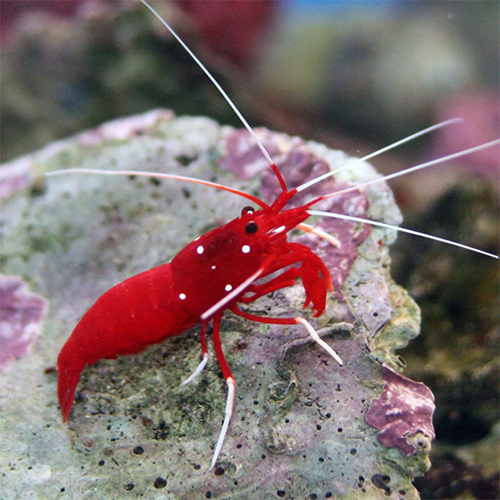
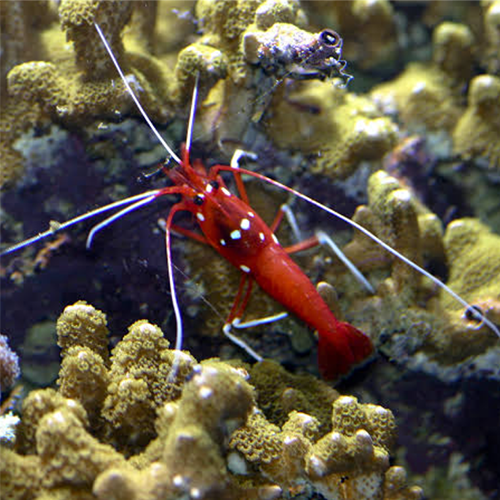
The Lysmata debelius, widely known as the Fire Shrimp or Blood Red Fire Shrimp, is one of the most popular and aesthetically striking ornamental invertebrates in the marine hobby. Renowned for its brilliant crimson color and white spots, it is as functional as it is beautiful, serving as a dedicated scavenger and cleaner.
- Temperament: Peaceful and shy.
- Size: Grows to approximately 5–6 cm.
- Key Trait: Nocturnal by nature, though they often become bolder and more active during daylight hours once they feel secure in the aquarium.
- Role: They are excellent “cleaner” shrimp, known for setting up cleaning stations to remove parasites and dead tissue from the fish in your tank.
Care Requirements
- Tank Size: Minimum 40 litres. They are adaptable to various tank sizes as long as water quality is maintained.
- Temperature: 22–26°C.
- Salinity: 1.023–1.025 SG.
- pH: 8.1–8.4.
- Acclimation (Crucial): Fire Shrimp are extremely sensitive to changes in salinity and pH. They require a slow, drip-acclimation process over 60–90 minutes to ensure they adjust to your tank’s water chemistry without shock.
- Environment: They require plenty of live rock with caves and crevices where they can hide and molt safely. They prefer dim lighting; if your tank is brightly lit, ensure they have deep, dark caves to retreat into.
Maintenance
- Water Quality: They are sensitive to high levels of nitrates and are extremely sensitive to copper-based medications, which are lethal to them. Never use copper in a tank containing these shrimp.
- Routine: Regular, stable water changes are necessary. Keep iodine levels appropriate, as iodine is essential for the molting process.
Diet
- Type: Omnivore/Scavenger.
- Staples: They are not picky eaters. They will happily consume leftover fish food, detritus, and scavenging scraps. Supplement their diet with high-quality sinking pellets, frozen mysis or brine shrimp, and bits of fresh seafood.
- Feeding Habits: They will often emerge from their caves when they smell food in the water column. If they are shy, you can target-feed them using long feeding tongs.
Behavior and Compatibility
- Tankmates: They are peaceful and compatible with almost all reef-safe fish.
- Avoid: Do not house with aggressive predators that eat crustaceans, such as large Hawkfish, Triggerfish, Groupers, or large Wrasses.
- Social: They can be kept singly or in pairs. If keeping a pair, they are simultaneous hermaphrodites and will readily spawn in the aquarium.
- Reef Safety: Completely reef-safe. They will not bother corals or sessile invertebrates.
Reproduction
- They are hermaphroditic and can reproduce in captivity.
- Spawning is common, but successfully raising the larvae is very difficult. The larvae require a specialized diet (phytoplankton and rotifers) and a dedicated rearing environment, as most will be consumed by tank inhabitants or filtered out by equipment.
Tips
- Molting: You may occasionally see a transparent “husk” in your tank—this is their old exoskeleton. Do not remove it immediately; the shrimp will often eat it to reclaim necessary minerals.
- No Copper: Always verify that any medication, additive, or treatment is “invertebrate-safe” before adding it to your tank.
- Acclimation: Do not rush the drip-acclimation process. Patience here is the difference between a thriving shrimp and a lost one.
Picture for illustrative purposes only. Either come in store to view available stock or request pictures to be sent to you.
Please Note: Due to variations within species resulting from age, region, sex, etc., the actual livestock may not look identical to the image. Approximate size range may also vary between individual specimens.