Description
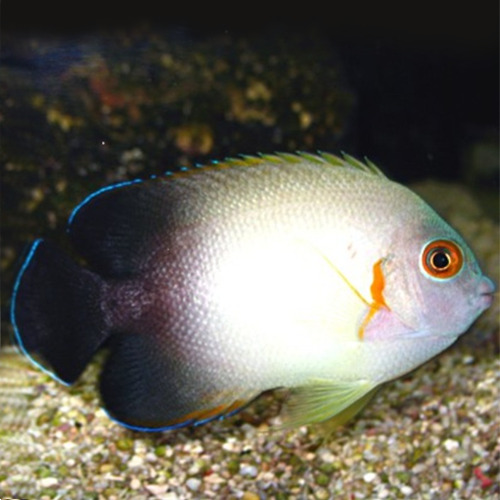
Half Black Angelfish (Centropyge vroliki)
Overview
The Pearlscale Angelfish (Centropyge vroliki), also commonly known as the Half-Black Angelfish, is a popular, hardy, and attractive dwarf angelfish. While highly desirable for their unique color pattern, they require careful consideration regarding their reef-safe status.
- Temperament: Semi-aggressive (can be territorial toward other dwarf angelfish)
- Reef Safe: With caution (may nip at corals)
- Max Size: Approximately 10 cm
- Origin: Indo-Pacific (Indonesia, Philippines, Japan, and the Great Barrier Reef)
Care Requirements
- Tank Size: A minimum of 200 litres is recommended to provide sufficient territory and reduce aggression.
- Aquascape: They require a tank with plenty of live rock for grazing and hiding. They appreciate structures with many crevices to explore.
- Water Parameters:
- Temperature: 22–28°C
- Salinity: 1.020–1.025
- pH: 8.1–8.4
Maintenance
- Stable Environment: Like most marine angelfish, they are sensitive to rapid fluctuations in water parameters. Consistent weekly maintenance and stable salinity are key.
- Grazing Areas: Keep the rockwork clean but allow some natural algae growth, as this provides a supplemental food source.
Diet
- Feeding Frequency: Feed 2–3 times daily.
- Dietary Needs: As an omnivore, they need a varied diet that includes both meaty foods and algae.
- Staples: High-quality spirulina-enriched flake or pellet food.
- Variety: Frozen mysis shrimp, brine shrimp, and chopped krill.
- Natural Grazing: They will constantly graze on filamentous algae and diatoms on the live rock. Providing a piece of Nori (dried seaweed) on a clip is an excellent way to supplement their diet.
Behavior and Compatibility
- Social Behavior: They are generally solitary. If you wish to keep more than one, the tank must be very large, or they must be introduced simultaneously as a mated pair.
- Compatibility: They can be territorial, especially toward other Centropyge species or fish with similar body shapes. It is usually best to add them to the tank last or near the end of your stocking process to prevent them from claiming the entire tank as their territory.
- Reef Caution: While many individuals are fine, some specimens have been known to nip at soft corals (like Zoanthids) and certain Large Polyp Stony (LPS) corals. Individual personality varies significantly.
Reproduction
Centropyge species are protogynous hermaphrodites, meaning they begin as females and can change into males if no male is present. Captive breeding is extremely difficult and rarely successful in a home aquarium setting.
Tips
- Patience with Grazing: If your tank is relatively new, ensure there is enough natural algae growth or supplement with high-quality algae-based foods, as they rely on grazing for their long-term health.
- Monitoring: If you notice them nipping at your corals, you may need to increase their feeding frequency to see if they are simply hungry. If the behavior persists, you may need to choose between the fish and the corals.
- Environment: They are generally more active and less shy when kept in a well-lit tank with plenty of rockwork that mimics their natural environment.
Picture for illustrative purposes only. Either come in store to view available stock or request pictures to be sent to you.
Please Note: Due to variations within species resulting from age, region, sex, etc., the actual livestock may not look identical to the image. Approximate size range may also vary between individual specimens.


