Description
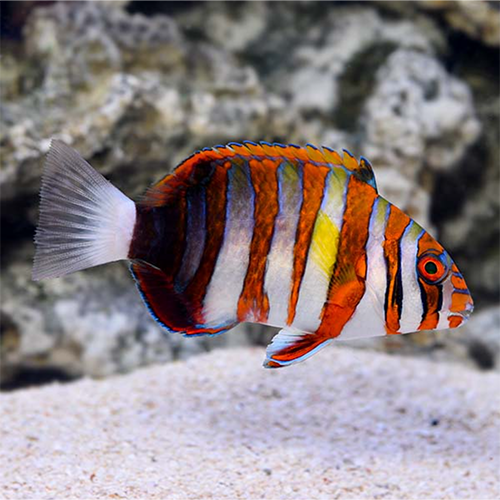
Harlequin Tusk (Choerodon fasciatus)
Overview
The Harlequin Tuskfish (Choerodon fasciatus) is a highly charismatic and visually striking member of the wrasse family, famous for its “tiger-striped” orange and white bands, blue-tinged margins, and prominent, tusk-like teeth.
- Difficulty: Moderate
- Temperament: Semi-aggressive/Territorial
- Adult Size: Up to 25–30 cm
- Minimum Tank Size: 400–500 litres. While they don’t require vast swimming space like some other fish, they grow large and produce a significant bioload.
Care Requirements
- Origin Matters: Specimens collected from Australia are widely considered hardier, more colorful, and better acclimated to aquarium life than those from Indonesia or the Philippines. It is highly recommended to seek out Australian-sourced specimens.
- Aquascape: They require plenty of live rock with substantial caves and crevices to feel secure. Unlike many other wrasses, they do not bury themselves in the sand at night.
- Lid: A secure, tight-fitting lid is essential. While they are not the most active jumpers compared to some other wrasses, their speed and confidence make a covered tank a smart safety precaution.
- Water Parameters:
- Temperature: 24–28°C
- Salinity: 1.020–1.025 SG
- pH: 8.1–8.4
Maintenance
- Water Quality: Maintaining pristine water conditions is vital. Because they are messy eaters that produce a high bioload, a robust protein skimmer and consistent weekly water changes are highly recommended.
- Aquascaping: They do not bury themselves in the sand like many other wrasses, but they require ample live rock with deep crevices and caves to retreat into when shy. Because they are known to rearrange rocks and substrate while searching for food, ensure all rockwork is structurally secure (glued or epoxied) so it cannot topple.
- Equipment Safety: Large, confident individuals have been known to splash water out of the tank. Ensure your electrical installations are placed safely away from potential splashes or covered.
- Dietary Maintenance: Feed high-quality, protein-rich, meaty foods (such as mysis, krill, squid, or clam) 3–4 times daily to match their high metabolism.
Diet
- Nature: They are carnivores that hunt benthic invertebrates in the wild.
- Feeding: They are voracious eaters. Offer a varied, meaty diet consisting of frozen mysis shrimp, chopped krill, squid, clam, and high-quality marine pellets.
- Frequency: Their high metabolism requires small feedings 3–4 times daily rather than one single large meal.
Behavior and Compatibility
- Solitary Species: Keep only one per tank. They are highly territorial and will fight with their own kind and similar-looking species.
- Reef Safety: They are not reef safe in the traditional sense. While they generally leave corals alone, they will actively hunt and consume ornamental crustaceans (shrimp, crabs, snails, etc.).
- Tank Mates: Best suited for “Fish-Only with Live Rock” (FOWLR) systems. Good tank mates include tangs, larger angelfish, or triggerfish that can hold their own. Avoid small, docile fish that could be viewed as a snack.
- Personality: They are known for being exceptionally interactive. Many owners report that their Tuskfish becomes “dog-like,” greeting them at the glass during feeding time.
Reproduction
- Biology: Like many wrasses, they are protogynous hermaphrodites, meaning all are born female, and the most dominant individual will transition into a male.
- Captive Breeding Status: While there have been documented successes in large-scale aquaculture facilities (most notably by Bali Aquarich), these breakthroughs involved thousands of gallons of water and years of trial and error.
- Challenges: In a home aquarium, the territorial nature of the fish makes it nearly impossible to keep a pair or harem long enough for natural pairing and spawning behaviors to occur. Furthermore, the larval rearing process for this species is highly complex and currently beyond the reach of standard home-hobbyist setups.
Tips
- Introduction: Newly introduced Tuskfish can be quite shy. Ensure your tank has plenty of hiding spots so they can settle in comfortably.
- Water Quality: Because they are large, messy eaters, they place a high demand on water filtration. A high-quality protein skimmer and regular water changes are necessary to keep nitrates and phosphates in check.
- Avoid Small Inverts: If you value your cleaner shrimp, emerald crabs, or snails, do not house them with a Harlequin Tuskfish—they will eventually become part of the Tuskfish’s diet.
Picture for illustrative purposes only. Either come in store to view available stock or request pictures to be sent to you.
Please Note: Due to variations within species resulting from age, region, sex, etc., the actual livestock may not look identical to the image. Approximate size range may also vary between individual specimens.