Description
MacCulloch’s rainbowfish (Melanotaenia maccullochi)
Overview
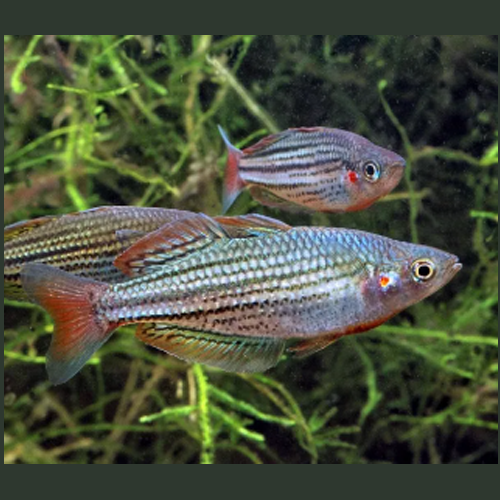
Melanotaenia maccullochi, commonly known as the dwarf rainbowfish or MacCulloch’s rainbowfish, is a small, vibrant freshwater fish from the Melanotaeniidae family, native to northern Australia and southern Papua New Guinea. Found in diverse habitats like clear streams, turbid ponds, and grassy swamps with dense vegetation, it displays horizontal dark stripes and variable fin colours (red, yellow, or orange) depending on locality. Growing to 7 cm, males are more colourful with longer dorsal and anal fins, while females are deeper-bodied and duller. Its peaceful, adaptable nature and small size make it ideal for planted community tanks, though fry rearing can be challenging. Most aquarium specimens are captive-bred due to its Least Concern status but localized habitat threats.
Care Requirements
- Aquarium Size: Because of their smaller adult size and active nature, a minimum tank size of 70 to 90 liters (approx. 60 to 75 cm or 2 feet in length) is suitable for a small group.
- Water Parameters:
- Temperature: 24°C to 30°C
- pH: 6.0 to 7.5 (they are quite adaptable, tolerating slightly acidic to neutral water conditions well)
- General Hardness (GH): 5 to 15°H
- Filtration & Flow: Moderate filtration with gentle to moderate water movement. They appreciate clean, well-oxygenated water with minimal accumulation of organic waste.
Maintenance
- Aquascaping: Replicate a slow-flowing stream, creek, or billabong environment by utilizing a sandy substrate, pieces of driftwood, and dense peripheral or background planting (such as Vallisneria, sword plants, or floating plants to diffuse bright lighting). Leaving an open central area for swimming is ideal.
- Water Quality & Changes: Perform routine partial water changes (20% to 25% bi-weekly) to maintain water purity. A secure lid is recommended, as most rainbowfish are capable jumpers when startled.
Diet
- Nature: Omnivorous micro-predators in the wild, feeding on small aquatic insects, insect larvae, and microscopic crustaceans.
- Staple Diet: High-quality crushed flakes, micro-pellets, or fine granular foods.
- Enhancing Color & Vitality: Supplement their daily diet regularly with live or frozen foods such as baby brine shrimp, cyclops, daphnia, and finely chopped bloodworms. Including quality vegetable matter or spirulina is also beneficial.
Behaviour and Compatibility
- Temperament: Peaceful, active, and schooling. They occupy the middle and upper levels of the water column.
- Shoaling Needs: Must be kept in a group of at least 6 to 8 individuals (with a balanced male-to-female ratio or more females). Keeping them isolated or in pairs causes stress and dulls their coloration.
- Tank Mates: Excellent for peaceful community tanks with other small, non-aggressive species. Good tank mates include other tiny or dwarf rainbowfish species, peaceful tetras, small rasboras, and bottom-dwellers like small Corydoras or shrimp. Avoid keeping them with large, predatory, or overly boisterous fish that might intimidate them or view them as prey.
Breeding Behaviour
- Spawning Setup: Set up a small, heavily planted breeding aquarium featuring fine-leaved plants like Java moss or artificial spawning mops, paired with a gentle sponge filter.
- Conditioning: Condition breeding groups with frequent, small feedings of high-protein live and frozen foods. Males will flare their colorful fins and spar gently to catch the attention of females.
- The Process: As continuous spawners, females deposit small numbers of adhesive eggs among the vegetation or spawning mop each morning, which are immediately fertilized by the males.
- Raising Fry: Adults will predate on their eggs and fry, so spawning mops should be checked and moved to a separate rearing tank periodically. The tiny fry hatch in about 7 days and require microscopic foods like infusoria or liquid fry food initially before accepting newly hatched brine shrimp.
Picture for illustrative purposes only. Either come in store to view available stock or request pictures to be sent to you.
Please Note: Due to variations within species resulting from age, region, sex, etc., the actual livestock may not look identical to the image. Approximate size range may also vary between individual specimens.