Description
Otocinclus Catfish (Macrotocinclus affinis)
Overview
The Otocinclus Catfish (Macrotocinclus affinis), often affectionately referred to as the “Oto” or dwarf oto, is a tiny, highly peaceful freshwater sucker-mouth catfish native to the coastal rivers and streams of southeastern Brazil.
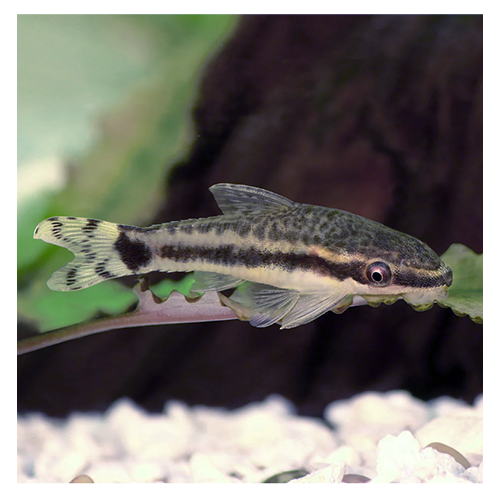
- Appearance: Features an elongated, slender body with a flattened belly adapted for clinging to surfaces. They display an earthy brownish-olive back that fades to a silvery-white belly, accented by a distinctive, dark horizontal stripe running from the snout all the way through to the tail fin.
- Size: Grows to a maximum length of about 3.5 to 5 cm (1.5 to 2 inches), making them one of the smallest and most popular algae-eating catfish in the aquarium hobby.
- Lifespan: Typically 3 to 5 years under optimal aquarium conditions.
Care Requirements
- Aquarium Size: Because of their tiny size, a small group can be housed in nano aquariums starting at 40 to 50 liters (approx. 10 to 15 gallons).
- Water Parameters:
- Temperature: 20°C to 26°C (68°F to 79°F)
- pH: 6.0 to 7.5 (they prefer slightly acidic to neutral water)
- General Hardness (GH): 2 to 15°H (soft to moderately hard water)
- Filtration & Flow: Excellent filtration with moderate to good water movement is essential. Otocinclus are native to fast-flowing, well-oxygenated streams and are quite sensitive to poor water quality or high organic waste.
Maintenance
- Aquascaping: They thrive in a well-established, mature aquarium featuring plenty of live plants, smooth driftwood, and rock surfaces that naturally accumulate green or brown algae. A planted setup with a soft sand or fine gravel substrate is ideal.
- Water Quality & Changes: Perform routine partial water changes (20% weekly) to maintain pristine conditions. Otocinclus are notoriously sensitive to sudden water parameter shifts and high nitrates, so they should only ever be introduced into a well-cycled, mature aquarium (ideally running for at least several months).
Diet
- Nature: Specialized herbivorous algae-grazers. In the wild, they scrape microscopic algae, bio-films, and small microorganisms off submerged rocks and plants.
- Staple Diet: While they will graze constantly on tank surfaces, natural algae alone is rarely enough in a home aquarium. Supplementary feeding is mandatory. Provide high-quality sinking algae wafers, spirulina tablets, and blanched vegetables (such as zucchini, cucumber, shelled peas, or blanched spinach).
- Ensuring Proper Nutrition: Because they are slow eaters, ensure food is placed near where they hang out so faster tank mates don’t outcompete them.
Behaviour and Compatibility
- Temperament: Exceptionally peaceful, gentle, and entirely harmless to other fish, shrimp, or snails. They spend much of their time clinging to glass, decorations, or plant leaves.
- Shoaling Needs: This is a social, schooling species that must be kept in a group of at least 6 individuals. Keeping them alone causes extreme stress, hiding behavior, and a drastically shortened lifespan.
- Tank Mates: Ideal for almost any peaceful community aquarium. Perfect companions include tiny nano fish, rasboras, tetras, livebearers, gouramis, dwarf shrimp, and peaceful bottom-dwellers. Avoid housing them with large, predatory, or aggressive fish (like large cichlids) that might view them as a snack, as their rigid, spiny fins can pose a choking hazard to predators.
Breeding Behaviour
- Spawning Setup: Breeding Otocinclus in a home aquarium is rare and usually happens by chance in heavily planted, mature community tanks. A dedicated breeding setup would require clean, well-oxygenated water, a sponge filter, and dense patches of fine-leaved plants or spawning mops.
- Conditioning: Condition groups with frequent feedings of high-quality algae wafers, blanched veggies, and live or frozen micro-foods.
- The Process: Spawning is often triggered by a large water change with slightly cooler water, mimicking seasonal rains. The pair engages in a brief chase before the female deposits small batches of adhesive eggs onto plant leaves, glass surfaces, or decorations, which are immediately fertilized.
- Raising Fry: Adults do not guard their eggs and may consume them if given the opportunity. The microscopic fry hatch in about 3 days and require very fine foods like infusoria, green water, or specialized liquid fry foods before they are large enough to graze on bio-films and micro-algae.
Picture for illustrative purposes only. Either come in store to view available stock or request pictures to be sent to you.
Please Note: Due to variations within species resulting from age, region, sex, etc., the actual livestock may not look identical to the image. Approximate size range may also vary between individual specimens.