Description
Queen Arabesque Plecostomus (Hypancystrus sp.) L-260
Overview
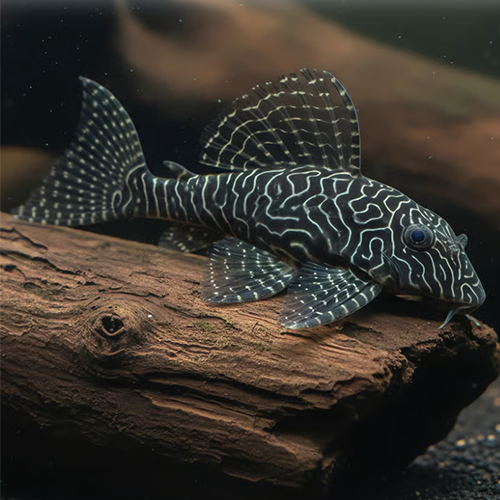
The Queen Arabesque Plecostomus L-260 (Hypancistrus sp.) is a small, intricately patterned armored catfish native to the lower Rio Tapajós basin in Pará, Brazil. Named for its dark brown-to-black body covered in fine white or cream squiggly lines and spots, this peaceful dwarf pleco stays compact enough for smaller aquariums while living over 10 to 15 years.
Care Requirements
Tank Size:
A 75 to 100 litre aquarium is suitable for a single fish or a small pair.
Care Level:
Easy to moderate, provided their need for warm, clean, heavily oxygenated water is met.
Water Parameters:
- Temperature: 24–30°C optimal for breeding
- pH: 6.0–7.5 (slightly acidic to neutral)
- Hardness: 1–15 dGH (soft to moderately hard water)
- Filtration & Aeration. Use an oversized canister filter, sponge filter, or small powerhead alongside an air stone to maintain brisk circulation and surface agitation.
Aquarium Setup:
- Substrate. Use fine sand or smooth, rounded gravel so they can rest and forage along the bottom without scratching their soft undersides.
- Caves & Rockwork. Provide plenty of stacked slate, smooth river stones, and dedicated terracotta or slate pleco caves. Supply at least one cave per adult so each fish can claim a secure daytime retreat.
- Driftwood & Lighting. Include driftwood for natural cover and grazing biofilm, even though L-260s do not rely on wood fiber for digestion like Panaque plecos. Keep aquarium lighting subdued or shaded with floating plants.
Maintenance
- Weekly Water Changes. Perform a 25% to 30% weekly water change using dechlorinated, temperature-matched water to keep dissolved wastes low.
- Debris Removal. Lightly siphon around rockwork and caves during water changes so uneaten meaty foods do not foul the water.
- Filter Maintenance. Rinse mechanical filter sponges in removed aquarium water every 2 to 4 weeks to prevent clogs that reduce oxygen flow.
Diet
- Carnivorous Omnivore. Unlike Bristlenose Plecos, L260 are poor algae eaters and require a protein-rich diet.
- Staple Foods. Feed sinking carnivore pellets, high-protein wafers, and Repashy gel foods formulated for omnivorous or carnivorous bottom-dwellers.
- Meaty & Plant Treats. Offer frozen or live bloodworms, Mysis shrimp, brine shrimp, and daphnia several times a week, alongside occasional slices of blanched zucchini.
- Nocturnal Feeding. Drop food into the tank right after turning off the aquarium lights so shy individuals can eat without daytime competition.
Behaviour and Compatibility
- Temperament. L-260s are peaceful, shy, and mostly nocturnal. Adult males can become territorial toward each other over prime caves, though serious injuries are rare when ample hiding spots exist.
- Ideal Tankmates. Pair them with peaceful mid-to-upper water fish that thrive in warm, fast-flowing water, such as Rummy Nose Tetras, Cardinal Tetras, Pencilfish, Hatchetfish, and small Rasboras.
- Tankmates to Avoid. Avoid large, boisterous bottom-dwellers (such as big Botia loaches, aggressive cichlids, or large plecos) that will bully them away from food. Do not house them with other Hypancistrus species to prevent cross-breeding and hybridization.
Breeding Behaviour
- Sexual Dimorphism. Mature males develop longer cheek odontodes (whiskers) and prominent, spiny odontodes along the leading edges of their pectoral fins and tail base. Females look noticeably broader and rounder through the midsection when viewed from above, especially when carrying eggs.
- Cave Spawning. L-260s are secretive cave spawners. Provide narrow, dead-end caves roughly twice the male’s length and barely wider than his body so he can easily trap a female inside and guard the entrance.
- Spawning & Fry Care. Conditioning adults on high-protein foods, raising the temperature to 28°C–30°C, and performing frequent slightly cooler water changes mimics the rainy season and triggers spawning. The female lays 10 to 25 large yellow eggs inside the cave, which the male fans and guards until they hatch in 5 to 7 days. Once fry absorb their yolk sacs at around two weeks old, feed them baby brine shrimp, microworms, and crushed high-protein pellets.
Please Note: Due to variations within species resulting from age, region, sex, etc., the actual livestock may not look identical to the image. Approximate size range may also vary between individual specimens.


