Description
Blue Lacustrus Rainbow (Melanotaenia lacustrus)
Overview
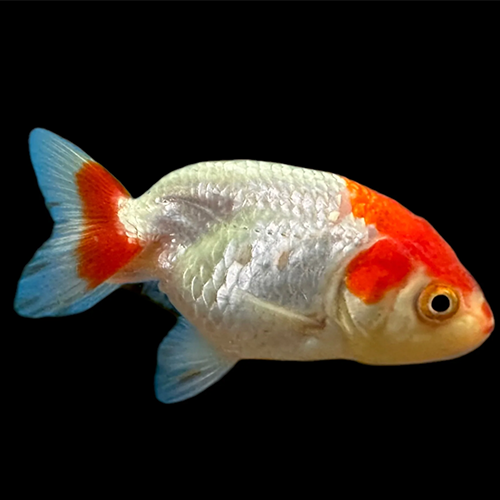
The Ranchu Goldfish (Carassius auratus), often referred to as the “King of the Fancy Goldfish” in Japan, is one of the most highly prized and distinctive fancy goldfish varieties.
- Appearance: Features a deep, egg-shaped body completely devoid of a dorsal fin, which gives its back a smooth, curved arch. It is characterized by its broad, downward-sloping face and a heavily developed, raspberry-like fleshy hood (wen) that covers its head, cheeks, and opercles. They come in various colorations, including solid orange, red-and-white, calico, black, and bi-color combinations.
- Size: Grows to a robust size, typically reaching 15 to 20 cm (6 to 8 inches) in length, with a heavy, rounded profile.
- Lifespan: With proper care and pristine water conditions, they commonly live 10 to 15 years or more.
Care Requirements
- Aquarium Size: Because of their bulky bodies, deep profiles, and heavy waste production, a minimum aquarium size of 150 to 200 liters (approx. 40 to 50 gallons) is recommended for a single Ranchu, adding an extra 75 to 100 liters for each additional fish.
- Water Parameters:
- Temperature: 18°C to 24°C (65°F to 75°F). They are a cold-water species and do not tolerate high tropical temperatures long-term.
- pH: 6.5 to 8.0 (thrives best in neutral to slightly alkaline water)
- General Hardness (GH): 10 to 20°H
- Filtration & Flow: Heavy-duty filtration is essential to process their large waste output. However, water flow should be kept gentle to moderate, as their round bodies and lack of a dorsal fin make them clumsy swimmers that struggle against strong currents.
Maintenance
- (often obstructed by their head wen) and delicate bodies, avoid sharp rocks, rough driftwood, or jagged decorations that could scratch them or snag their wens. Use smooth river rocks, a bare-bottom setup, or a fine, smooth sand substrate. If keeping live plants, choose tough, established species like Anubias or Java Fern, as soft-leaved plants will be uprooted and eaten.
- Water Quality & Changes: Perform routine partial water changes (25% to 30% weekly) to control nitrate levels and maintain overall water stability.
Diet
- Nature: Omnivorous and enthusiastic bottom and mid-water feeders with a constant appetite.
- Staple Diet: High-quality sinking goldfish pellets or gel foods. Sinking foods are strongly recommended over floating flakes or pellets to prevent Ranchus from gulping surface air, which frequently leads to buoyancy and swim bladder control issues due to their compressed body shape.
- Vegetable Matter: They require a fiber-rich diet to support healthy digestion. Supplement their dry foods regularly with blanched vegetables (such as shelled peas, zucchini, spinach, or cucumber) and occasional treats of daphnia or brine shrimp.
Behaviour and Compatibility
- Temperament: Gentle, peaceful, slow-moving, and inquisitive. They spend much of their time leisurely sifting through the substrate in search of food.
- Social Needs: They are social fish that thrive in the company of their own kind. Keep them in pairs or small groups in an appropriately sized tank.
- Tank Mates: Ideal for tanks with other slow-moving, fancy goldfish varieties (such as Orandas, Fantails, or Lionheads). Avoid housing them with fast, streamlined single-tailed goldfish (like Comets or Shubunkins) because the speedy fish will aggressively outcompete the Ranchus for food. Never keep them with tropical fish or nippy species.
Breeding Behaviour
- Spawning Setup: Spawning typically requires a separate, well-filtered breeding tank with cool-water triggers, bare glass or fine-leaved spawning mops, and gentle aeration.
- The Process: Males develop small white tubercles (breeding stars) on their gill covers and pectoral fins. They will enthusiastically chase and nudge females around the tank, prompting the female to release thousands of sticky, clear eggs over the vegetation or substrate, which the male immediately fertilizes.
- Raising Fry: Adult Ranchus will readily eat their own eggs. If breeding is successful, the egg-laden mops or parents should be separated immediately. The tiny fry hatch in 4 to 7 days, hanging vertically before becoming free-swimming, at which point they require microscopic infusoria or liquid fry food followed by newly hatched brine shrimp.
Picture for illustrative purposes only. Either come in store to view available stock or request pictures to be sent to you.
Please Note: Due to variations within species resulting from age, region, sex, etc., the actual livestock may not look identical to the image. Approximate size range may also vary between individual specimens.