Description
Red Whiptail Catfish (Rineloricaria sp.)
Overview
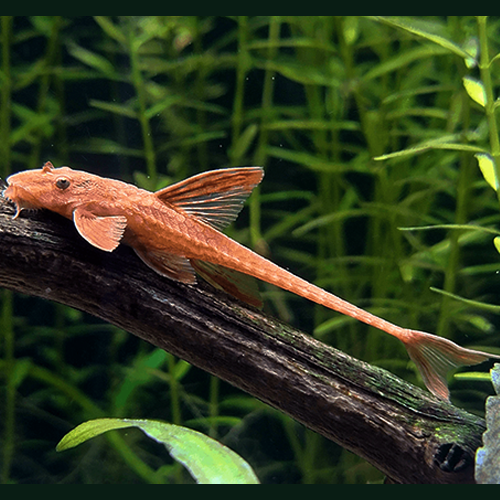
The Red Whiptail Catfish (Rineloricaria sp.), often referred to as the Red Lizard Catfish or Red Whiptail, is a stunning and uniquely adapted freshwater armored catfish belonging to the Loricariidae family, originating from South America.
- Appearance: Features an elongated, extremely flattened body with an extended, whip-like tail filament. Their standout characteristic is a warm, solid rust-red, reddish-brown, or vibrant copper coloration across their entire body. They possess a sucker-mouth adapted for grazing and fine armor plating covering their upper surfaces. Males develop bristly odontodes (hair-like growths) along the sides of their head and pectoral fins as they mature.
- Size: Typically grows to about 12 to 15 cm (4.5 to 6 inches) in length, including the long caudal filament.
- Lifespan: Often lives 5 to 8 years or more with proper care and stable water parameters.
Care Requirements
- Aquarium Size: Because of their elongated shape and peaceful bottom-dwelling nature, a minimum aquarium size of 80 to 100 liters (approx. 2 to 3 feet in length) is recommended for a pair or small group.
- Water Parameters:
- Temperature: 24°C to 28°C (75°F to 82°F)
- pH: 6.0 to 7.5 (they prefer slightly acidic to neutral water)
- General Hardness (GH): 2 to 12°H (soft to moderately hard water)
- Filtration & Flow: Good filtration with moderate water movement. They thrive in clean, well-oxygenated water that mimics a flowing river or stream edge.
Maintenance
- Aquascaping: Replicate a natural South American biotope by using a fine, soft sand substrate—which allows them to rest comfortably without scraping their bellies. Incorporate plenty of smooth driftwood branches, flat rocks, and subdued lighting with floating plants or marginal vegetation to make them feel secure.
- Water Quality & Changes: Perform routine partial water changes (20% weekly) to maintain pristine water conditions, as they can be sensitive to accumulating organic waste and high nitrates.
Diet
- Nature: Peaceful benthic omnivores that feed primarily on algae, bio-films, and small organic matter, though they readily accept supplementary foods.
- Staple Diet: High-quality sinking algae wafers, spirulina tablets, and vegetable pellets.
- Vegetable Supplementation: They require regular feedings of blanched vegetables (such as zucchini, cucumber, shelled peas, or spinach).
- Protein Boost: Supplement their diet occasionally with small live or frozen foods like daphnia, cyclops, or bloodworms, making sure food reaches the bottom where they can easily access it.
Behaviour and Compatibility
- Temperament: Exceptionally peaceful, shy, and largely sedentary during the day, becoming more active at dusk and night. They occupy the bottom-most level of the aquarium.
- Social Needs: Can be kept singly, as a bonded pair, or in a small peaceful group without issue.
- Tank Mates: Ideal for peaceful community setups. Good companions include small tetras, rasboras, livebearers, gouramis, and other non-aggressive bottom-dwellers like Corydoras catfish. Avoid housing them with large, highly aggressive, or predatory fish that might bully them or outcompete them for food during feeding time.
Breeding Behaviour
- Spawning Setup: Set up a dedicated breeding tank with soft, slightly acidic water, a bare or sandy bottom, gentle sponge filtration, and several narrow spawning tubes (such as ceramic or PVC pipes roughly matching the fish’s length).
- Conditioning: Condition a breeding pair with high-quality feedings of fresh vegetables and protein-rich frozen foods.
- The Process: The male will select and aggressively clean a cave or tube, enticing the female inside. Once she deposits the adhesive eggs on the inside surface of the tube, the male fertilizes them and then takes over exclusive parental care, vigorously guarding and fanning the eggs with his fins to keep them oxygenated.
- Raising Fry: The fry hatch in about 5 to 7 days. The guarding male can be left with the brood until they become free-swimming, after which the tube or fry should be moved. The tiny fry require micro-foods like newly hatched brine shrimp, finely crushed spirulina powder, and blanched vegetable purees to grow successfully.
Picture for illustrative purposes only. Either come in store to view available stock or request pictures to be sent to you.
Please Note: Due to variations within species resulting from age, region, sex, etc., the actual livestock may not look identical to the image. Approximate size range may also vary between individual specimens.