Description
Salmon Red Rainbow (Glossolepis incisus)
Overview
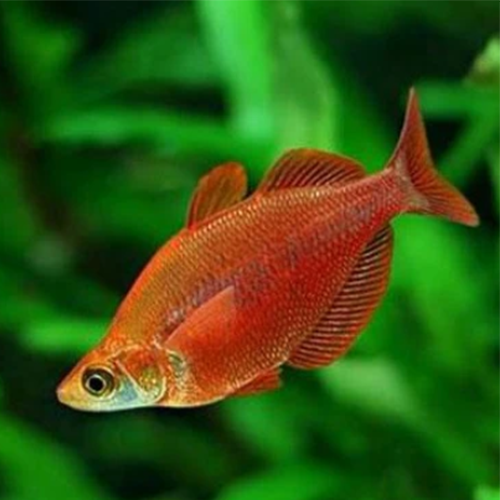
The Salmon-Red Rainbowfish (Glossolepis incisus), often simply called the Red Rainbowfish, is a vibrant freshwater species endemic to Lake Sentani and its surrounding tributary streams in West Papua, Indonesia.
- Appearance: Known for one of the most brilliant and intense solid red colorations in the hobby. Mature males develop a deep, high-backed body shape and an electric, glowing neon red or salmon-pink hue over metallic scales. Females and juveniles are significantly slimmer and display a duller, olive-green to silvery-yellowish body tone.
- Size: Grows to approximately 12 to 15 cm (4.5 to 6 inches) in length.
- Lifespan: Typically 5 to 8 years under proper care conditions.
Care Requirements
- Aquarium Size: Due to their active nature, deep-bodied shape, and large adult size, they require plenty of swimming space. A minimum tank size of 150 to 200 liters (approx. 4 feet or 120 cm in length) is recommended for a small group.
- Water Parameters:
- Temperature: 22°C to 27°C (72°F to 81°F)
- pH: 7.0 to 8.0 (they thrive best in hard, alkaline water)
- General Hardness (GH): 10 to 20°H
- Filtration & Flow: Strong biological filtration and good oxygenation are essential, keeping water movement moderate to match their natural lake environment.
Maintenance
- Aquascaping: Replicate a natural biotope by using a dark substrate to help accentuate their fiery red colors, combined with dense peripheral plantings (such as Vallisneria or sword plants) and a wide-open central lane for swimming. Driftwood branches and smooth rocks add a natural touch.
- Water Quality & Changes: Perform routine partial water changes (25% weekly) to control nitrates and keep the water pristine. A secure, tight-fitting aquarium lid is mandatory, as these active, fast swimmers are powerful jumpers.
Diet
- Nature: Omnivorous and enthusiastic feeders that consume a wide variety of foods.
- Staple Diet: High-quality flake foods, color-enhancing pellets, or granules.
- Enhancing Color & Vitality: To bring out their maximum brilliant red coloration, supplement their daily diet regularly with live or frozen foods such as brine shrimp (Artemia), daphnia, mysis shrimp, and bloodworms. Including vegetable matter or spirulina flakes is also beneficial.
Behaviour and Compatibility
- Temperament: Highly peaceful, active, and social. They occupy the middle and upper levels of the water column.
- Shoaling Needs: This is a strict schooling species that must be kept in a group of at least 6 to 8 individuals (ideally with more females than males to spread out male attention). Keeping them alone or in tiny groups leads to stress, faded colors, and immune suppression.
- Tank Mates: Excellent for peaceful community setups. Good companions include other large, peaceful rainbowfish species, robust tetras, large barbs, danios, and bottom-dwellers like Corydoras catfish or loaches. Avoid housing them with slow-moving, shy, or tiny nano fish that could be intimidated by their rapid movements.
Breeding Behaviour
- Spawning Setup: Set up a separate breeding tank with mature hard water, gentle sponge filtration, and dense patches of fine-leaved plants or artificial spawning mops.
- Conditioning: Condition breeding groups with frequent, high-protein feedings of live and frozen foods. Mature males will display intense, glowing red colors and posture dramatically to court females.
- The Process: As continuous egg-scatterers, pairs will dash into the vegetation in the morning hours to release small batches of adhesive eggs, which are fertilized immediately. Spawning occurs daily over an extended period.
- Raising Fry: Adults will eat their own eggs and fry, so spawning mops should be regularly inspected and moved to a separate rearing tank. The tiny fry hatch in roughly 7 to 10 days and require microscopic first foods like infusoria or liquid fry food before graduating to newly hatched brine shrimp.
Picture for illustrative purposes only. Either come in store to view available stock or request pictures to be sent to you.
Please Note: Due to variations within species resulting from age, region, sex, etc., the actual livestock may not look identical to the image. Approximate size range may also vary between individual specimens.