Description
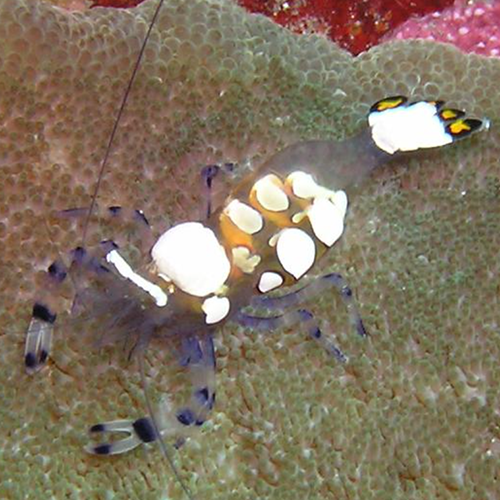
White-spot Anemone Shrimp (Periclimenes brevicarpalis)
Overview
The Periclimenes brevicarpalis, commonly known as the White-Spot Anemone Shrimp or Glass Anemone Shrimp, is a captivating and highly commensal crustacean. It is famous for its intricate symbiotic relationship with sea anemones, making it a highly prized “display” invertebrate for specialized marine reef tanks.
- Temperament: Peaceful.
- Size: Approximately 2–3 cm.
- Key Trait: They exhibit a “swaying” motion—often called a “dance”—which is thought to be a signal to potential host anemones or fish.
- Behavior: Obligate commensal; they are rarely seen far from their host anemone.
Care Requirements
- Tank Size: 40+ litres. While they are small, they require a healthy host to thrive.
- Temperature: 22–27°C.
- Salinity: 1.023–1.025 SG.
- pH: 8.1–8.4.
- Environment: The presence of a host anemone (such as Entacmaea quadricolor or various Stichodactyla species) is highly recommended for their long-term health. While they can survive without one, they are significantly more stressed and reclusive.
- Acclimation: Like all shrimp, they are sensitive to changes in salinity. Use a slow, drip-acclimation process over 60–90 minutes.
Maintenance
- Water Quality: Sensitive to high nitrates and rapid fluctuations in chemistry. Keep water parameters stable.
- Medication Warning: NEVER use copper-based medications in a tank with these shrimp, as they are lethal to all crustaceans.
- Routine: Weekly water changes (10%) are ideal to maintain mineral levels required for molting.
Diet
- Type: Omnivore/Scavenger.
- Staples: They are opportunistic feeders. They will consume fish food scraps, bits of frozen Mysis or brine shrimp, and even mucus produced by their host anemone.
- Feeding Habits: They are not fast swimmers. It is helpful to target-feed them using a pipette or long tongs to ensure they get enough nutrition.
Behavior and Compatibility
- Tankmates: Very peaceful. Compatible with almost all non-predatory, reef-safe fish.
- Avoid: Do not house with predatory fish that naturally consume shrimp, such as Triggerfish, Groupers, large Hawkfish, or larger Wrasses.
- Social: Best kept singly or as a mated pair. If the tank is large enough with multiple anemones, you may keep more than one pair, but they can be territorial toward their own kind.
- Reef Safety: Completely reef-safe.
Reproduction
- They are often seen carrying eggs under their abdomen.
- Captivity: Successfully raising the larvae is extremely difficult. The larvae have a long pelagic stage and require specialized micro-foods and a dedicated breeding environment.
Tips
- Host Dependency: If you do not have an anemone, ensure you provide other high-quality hiding spots (like branching corals) where the shrimp can feel secure, though host-less survival is not guaranteed long-term.
- Molting: If you find a “ghost” of the shrimp in your tank, do not worry—it is likely just the shed exoskeleton. The shrimp will be soft and vulnerable for a day or two after molting; ensure it has a safe place to hide during this time.
- No Copper: Always triple-check that any coral dip or water additive is invertebrate-safe.
Picture for illustrative purposes only. Either come in store to view available stock or request pictures to be sent to you.
Please Note: Due to variations within species resulting from age, region, sex, etc., the actual livestock may not look identical to the image. Approximate size range may also vary between individual specimens.