Description
Albino Spotted Hoplo Catfish (Megalechis thoracata)
Overview
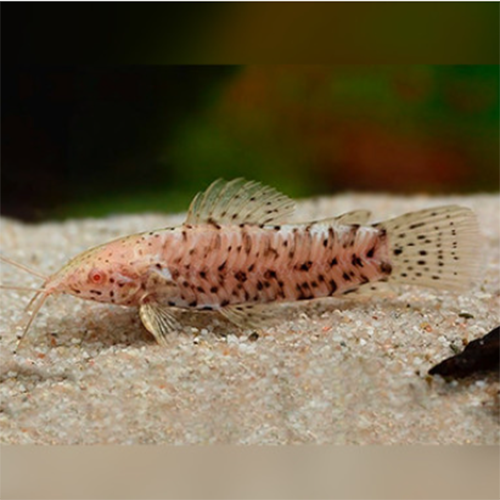
The Albino Spotted Hoplo Catfish (Megalechis thoracata) is a hardy, peaceful, armored freshwater catfish native to South America. Often described as a giant Corydoras, this captive-bred color morph features a pale pinkish-white body covered in dark speckles, pink eyes, and two pairs of prominent mouth barbels.
Care Requirements
Tank Size:
Minimum 180-200 liters for a small group.
Water Parameters:
- Temperature: 22–28°C
- pH: 6.0–7.8
- Hardness: 2–20 dGH
- Clean, well-oxygenated water with moderate to strong flow mimicking their natural riverine habitats.
Aquarium Setup:
- Substrate: Use fine sand or smooth, rounded gravel so the fish can sift through the bottom without eroding or injuring their sensitive barbels.
- Decor: Furnish the tank with driftwood, rock caves, and PVC pipes to provide shaded retreats during bright daytime hours.
- Sturdy Plants. Anchor hardy epiphytes like Anubias, Java fern, or Bolbitis to wood and rocks, as Hoplos may accidentally uproot delicate stem plants while foraging.
- Filtration: Strong filtration to maintain water quality; prefer high oxygen levels.
Maintenance
- Water Changes: Perform 20–30% water changes weekly to maintain water quality.
- Tank Cleaning: Regularly clean substrate and decorations to prevent detritus buildup, but leave some algae for grazing.
- Equipment Checks: Ensure filters and heaters are functioning properly, as SAEs are sensitive to poor water conditions.
- Monitoring: Watch for signs of stress (e.g., faded colours, lethargy) and test water parameters regularly.
Diet
- Opportunistic Omnivore. They readily accept sinking catfish pellets, algae wafers, and spirulina tabs.
- Meaty Supplements. Offer frozen or live foods such as bloodworms, brine shrimp, blackworms, and chopped earthworms two to three times a week.
- Feeding Strategy. Because they become boisterous at mealtime, scatter food across multiple spots in the tank—ideally just before lights out—so shyer bottom-dwellers still get their share
Behaviour and Compatibility
- Social Temperament. These catfish are semi-social and display the most confident, playful behavior when kept in groups of three to five or more.
- Community Tankmates. They are peaceful toward fish too large to swallow. Good companions include medium-to-large tetras (such as Congo or Bleeding Heart Tetras), rainbowfish, barbs, gouramis, and peaceful cichlids.
- Tankmates to Avoid. Do not house them with tiny fish like Neon Tetras or guppies, which may be eaten overnight. Avoid overly aggressive cichlids that could outcompete or injure them.
Breeding Behaviour
- Sexual Dimorphism. Mature males develop larger pectoral fins with a thickened, bright orange-tinted first ray. Females appear noticeably rounder and broader when viewed from above.
- Bubble Nesting. Unlike most catfish, males build a floating bubble nest anchored beneath broad floating leaves or a piece of floating polystyrene.
- Spawning Triggers & Care. A large, slightly cooler water change mimics the rainy season and often triggers spawning. Once eggs are laid inside the nest, the male becomes fiercely territorial and guards the eggs until they hatch in 3 to 4 days, at which point the fry or parents should be separated.
Picture for illustrative purposes only. Either come in store to view available stock or request pictures to be sent to you.
Please Note: Due to variations within species resulting from age, region, sex, etc., the actual livestock may not look identical to the image. Approximate size range may also vary between individual specimens.