Description
Silvertip Tetra (Hasemania nana)
Overview
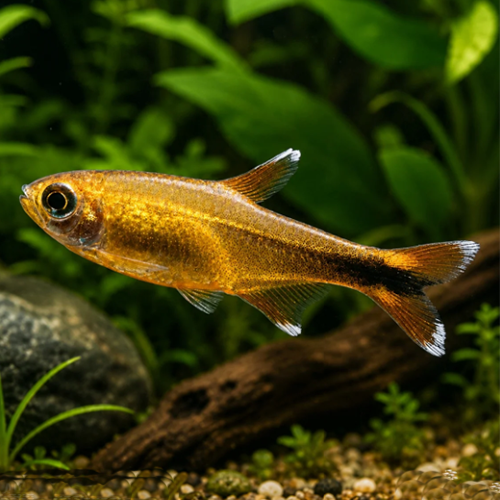
The Silvertip Tetra (Hasemania nana) is an energetic, hardy freshwater schooling fish native to the São Francisco River basin in Brazil. Recognizable by its warm copper-gold body, bright white-tipped fins, and lack of an adipose fin, it brings constant motion and sparkle to community aquariums.
Care Requirements
Tank Size:
A 70 to 75 litre aquarium is recommended to comfortably house a school.
Water Parameters:
- Temperature: 22–28°C
- pH: 6.0–8.0
- Hardness: 5–20 dGH (soft to moderately hard water)
- Water Stability. Maintain 0 ppm ammonia and nitrite while keeping nitrates below 20–30 ppm.
Aquarium Setup:
- Planted Layout. Surround the back and sides of the aquarium with dense stem plants, Java fern, or Vallisneria, leaving an open swimming lane across the front center. Heavy foliage breaks lines of sight and gives females resting spots from chasing males.
- Substrate & Hardscape. Dark sand or fine gravel makes their coppery-gold bodies and silver fin tips stand out sharply. Add driftwood branches and dried leaf litter if aiming for a natural Brazilian stream look.
- Tight-Fitting Lid. Keep the aquarium securely covered, as these fast swimmers can jump when startled during feeding or maintenance.
Maintenance
- Weekly Water Changes. Perform a 25% weekly water change using dechlorinated, temperature-matched water to keep dissolved wastes low.
- Substrate & Glass Care. Lightly vacuum open substrate areas during water changes and wipe algae from the viewing glass.
- Filter Upkeep. Rinse mechanical filter sponges in removed tank water every 2 to 4 weeks to maintain steady circulation without harming beneficial bacteria.
Diet
- Enthusiastic Omnivore. Silvertip Tetras are unfussy eaters that swarm eagerly at the surface and mid-water during mealtime.
- Staple Foods. Feed high-quality crushed flakes and micro-pellets that fit comfortably into their small mouths.
- Meaty Supplements. Offer frozen or live daphnia, brine shrimp, microworms, and finely chopped bloodworms two to three times a week to bring out rich copper-orange coloration.
- Feeding Tip. Feed small portions twice daily that they can finish within two minutes, and ensure slower bottom-dwellers receive sinking food afterward.
Behaviour and Compatibility
- Schooling Dynamics. Always keep them in groups of 8 to 10 or more (at least 6 as an absolute minimum). In larger schools, males focus their energy on harmless hierarchy sparring with each other rather than nipping tankmates.
- Ideal Tankmates. Pair them with active, similarly sized community fish such as Rummy Nose Tetras, Black Neon Tetras, Harlequin Rasboras, Zebra Danios, Cherry Barbs, Corydoras catfish, and dwarf cichlids.
- Tankmates to Avoid. Avoid slow-moving, long-finned fish like Bettas, Angelfish, or fancy Guppies, as Silvertip Tetras are notorious fin-nippers when housed with trailing fins.
Breeding Behaviour
- Sexual Dimorphism. Mature males develop a vibrant coppery-orange body with bright white fin tips and remain slimmer. Females appear noticeably rounder through the belly and display a paler, translucent lemon-yellow hue.
- Egg-Scattering Spawners. In a dedicated 40 to 60 litre (10–15 gallon) breeding tank with soft, slightly acidic water (pH 6.0–6.5, 2–5 dGH), warm temperatures (26°C–29°C), and fine-leaved plants or spawning mops, conditioned pairs scatter adhesive eggs at first light.
- Fry Care. Remove the adults immediately after spawning because they will eat their own eggs. Eggs hatch in 24 to 36 hours, and fry become free-swimming after 3 to 4 days, requiring infusoria or liquid fry food before transitioning to newly hatched brine shrimp.
Please Note: Due to variations within species resulting from age, region, sex, etc., the actual livestock may not look identical to the image. Approximate size range may also vary between individual specimens.