Description
Emerald Dwarf Rasbora (Rasbora Erythromicron)
Overview
The Emerald Dwarf Rasbora (Celichthys erythromicron, formerly Danio erythromicron), commonly known as the Emerald Dwarf Danio or Galaxy Rasbora relative, is a stunning, miniature freshwater fish endemic to Lake Inle in Myanmar (Burma).
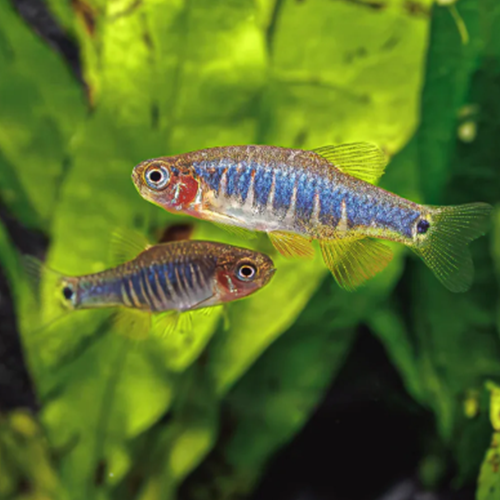
- Appearance: Features a striking iridescent, emerald-green to blue-green body crossed by numerous dark vertical bars or stripes, giving it a zebra-like appearance. Males display intense, vibrant green and blue hues with bright orange-red fins edged in white or black, while females are slightly fuller-bodied with more subdued, olive-green tones.
- Size: Grows to a maximum length of only about 2 to 2.5 cm (0.8 to 1 inch), making it a true nano fish.
- Lifespan: Typically 3 to 5 years under proper care conditions.
Care Requirements
- Aquarium Size: Because of their tiny size, a group can be comfortably maintained in a nano aquarium starting at 35 to 45 liters (approx. 10 gallons).
- Water Parameters:
- Temperature: 20°C to 26°C
- pH: 7.0 to 8.5 (they prefer hard, alkaline water mimicking their native high-altitude lake habitat)
- General Hardness (GH): 10 to 20°H
- Filtration & Flow: Moderate filtration with gentle water movement. Clean, well-oxygenated water is essential, though strong currents should be avoided.
Maintenance
- Aquascaping: They thrive in densely planted aquariums. Use a dark substrate to help bring out their iridescent colors, along with plenty of live plants (such as Cryptocorynes, Java fern, and mosses) and driftwood to provide secure hiding spots and visual barriers.
- Water Quality & Changes: Perform regular, small partial water changes (15% to 20% weekly) to maintain pristine water conditions without causing sudden chemical shifts. A tight-fitting lid is recommended to prevent accidental jumping.
Diet
- Nature: Micro-predators in the wild, feeding on tiny aquatic insects, crustaceans, and zooplankton.
- Staple Diet: High-quality micro-pellets, crushed fine flakes, or powdered foods formulated for nano fish.
- Enhancing Color & Health: Supplement their diet frequently with live or frozen foods sized appropriately for their tiny mouths, such as baby brine shrimp, cyclops, micro-worms, and daphnia.
Behaviour and Compatibility
- Temperament: Exceptionally peaceful, though they can be slightly shy when first introduced to a new tank. They occupy the middle and lower levels of the water column.
- Shoaling Needs: This is a gregarious schooling species that must be kept in a group of at least 8 to 10 individuals (preferably with more females than males). Keeping them in isolation causes chronic stress and hiding behavior.
- Tank Mates: Ideal for peaceful nano community tanks alongside other tiny species such as Chili Rasboras, Pygmy Corydoras, or freshwater dwarf shrimp (though very young shrimplets may occasionally be targeted). Avoid housing them with large, boisterous, or aggressive fish that will easily intimidate or outcompete them.
Breeding Behaviour
- Spawning Setup: Set up a dedicated breeding tank with a bare bottom or thick layers of Java moss and spawning mops, paired with a gentle sponge filter.
- Conditioning: Condition a group with frequent feedings of live and frozen micro-foods. Males will display vibrant colors and posture defensively toward rivals while courting females.
- The Process: Unlike egg-scatterers that abandon their young, females deposit small batches of adhesive eggs among fine vegetation over several days. Spawning typically happens in the morning hours.
- Raising Fry: Adults are voracious egg-eaters and will consume their spawn, so breeding mops or plants should be regularly removed to a separate rearing tank. The tiny fry hatch in 3 to 4 days and require microscopic first foods like infusoria or liquid fry food before they can accept baby brine shrimp.
Picture for illustrative purposes only. Either come in store to view available stock or request pictures to be sent to you.
Please Note: Due to variations within species resulting from age, region, sex, etc., the actual livestock may not look identical to the image. Approximate size range may also vary between individual specimens.