Description
Giant Kuhli Loach (Pangio myersi)
Overview
The Kuhli Loach (Pangio myersi), often referred to as the Myers’ Kuhli Loach or Giant Kuhli Loach, is a popular, eel-like freshwater fish native to Southeast Asia, specifically Thailand, Malaysia, and Indonesia.
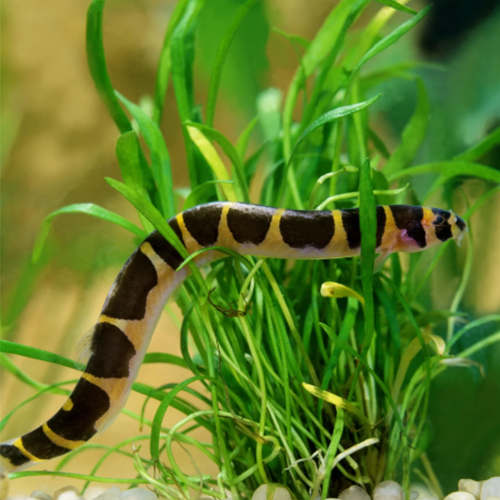
- Appearance: Features an elongated, slender, cylindrical body with a smooth, scaleless appearance. Its coloration ranges from a warm yellowish-brown to deep golden-orange, marked by numerous dark brown or black vertical saddle-like bands running down its length. It possesses three pairs of small barbels around its mouth and distinctive sub-ocular spines beneath its eyes.
- Size: Grows larger than some of its close relatives, typically reaching 10 to 12 cm (4 to 5 inches) in length.
- Lifespan: Exceptionally hardy when kept in proper conditions, often living 8 to 10 years or more.
Care Requirements
- Aquarium Size: Because of their active nature and social requirements, a minimum aquarium size of 80 to 100 liters (approx. 2 to 3 feet in length) is recommended for a small group.
- Water Parameters:
- Temperature: 24°C to 30°C (75°F to 86°F)
- pH: 6.0 to 7.0 (they thrive best in slightly acidic to neutral water)
- General Hardness (GH): 1 to 10°H (soft water is preferred)
- Filter & Flow: Gentle filtration with moderate water movement. Because of their eel-like flexibility and small size, filter intakes must be securely covered with a sponge pre-filter to prevent them from slipping inside. A tight-fitting lid is mandatory, as kuhli loaches are notorious for squeezing through tiny gaps or climbing up airline tubing.
Maintenance
- Aquascaping: A soft, fine sand substrate is essential for kuhli loaches, as they love to burrow and sift through the sand for food. Coarse gravel can scrape their delicate bodies and barbels. Provide plenty of hiding spots using driftwood, smooth river rocks, and dense plantings (such as cryptocorynes or Java ferns) to make them feel secure.
- Water Quality & Changes: Perform routine partial water changes (20% weekly) to maintain pristine water conditions, as they are sensitive to high nitrate levels and sudden chemical fluctuations.
Diet
- Nature: Omnivorous, peaceful bottom-dwellers that feed primarily as scavengers, sifting through the substrate for microscopic organisms and detritus.
- Staple Diet: High-quality sinking pellets, algae wafers, and small protein-rich sinking granules designed for bottom feeders.
- Enhancing Health: Supplement their diet regularly with live or frozen foods such as bloodworms, tubifex, daphnia, and brine shrimp. Because they are primarily nocturnal or active in dim lighting, feeding them just after the main aquarium lights go out ensures they get their share before faster mid-water fish eat everything.
Behaviour and Compatibility
- Temperament: Exceptionally peaceful, shy, and largely nocturnal, though established groups often become bolder and venture out during the day. They occupy the bottom-most level of the tank.
- Shoaling Needs: This is a strictly social species that must be kept in a group of at least 5 to 6 individuals (ideally more). Keeping a single kuhli loach leads to chronic stress, continuous hiding, and a shortened lifespan.
- Tank Mates: Perfect for peaceful community tanks. Ideal companions include small rasboras, tetras, gouramis, livebearers, and other non-aggressive bottom-dwellers like Corydoras catfish. Avoid housing them with large, aggressive, or predatory fish (such as large cichlids or territorial bottom-dwellers) that might bully or view them as prey.
Breeding Behaviour
- Spawning Setup: Breeding kuhli loaches in a home aquarium is exceptionally rare and usually happens by chance rather than design. If attempting a dedicated setup, use a dimly lit tank with soft, slightly acidic water, a fine sand substrate, and a dense tangle of Java moss or spawning mops.
- The Process: Spawning is typically triggered by changes in barometric pressure or large water changes simulating the onset of the rainy season. The pair will swim together in a swirling motion near the surface or amidst dense plants, releasing bright green, adhesive eggs that scatter among the vegetation or substrate.
- Raising Fry: The adults do not exhibit parental care and will consume their own eggs. If eggs are discovered, they should be transferred to a separate rearing tank. The microscopic fry hatch within 24 to 48 hours and require very fine first foods like infusoria or liquid fry food before graduating to newly hatched brine shrimp.
Picture for illustrative purposes only. Either come in store to view available stock or request pictures to be sent to you.
Please Note: Due to variations within species resulting from age, region, sex, etc., the actual livestock may not look identical to the image. Approximate size range may also vary between individual specimens.