Description
Similis Corydoras (Corydoras similis)
Overview
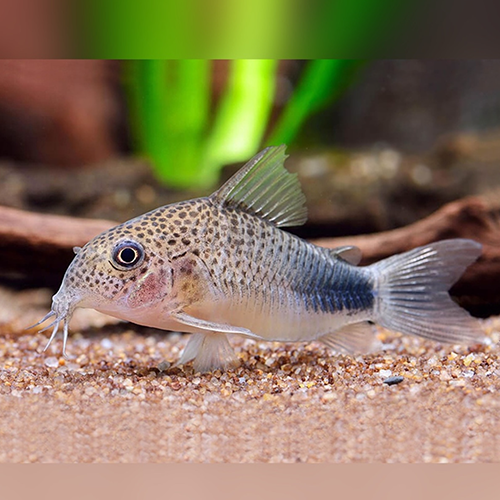
The Similis Corydoras (Corydoras similis), often referred to as the Similis Cory or Violet Corydoras, is a peaceful and charming freshwater armored catfish native to the upper Madeira River basin in the southern Amazon tributaries of Brazil and Bolivia.
- Appearance: Features a silvery-white to pale golden body complemented by a striking, unique color gradient. Its most distinctive characteristic is a prominent, dark charcoal-black patch covering the upper half of its caudal peduncle (tail base), accompanied by a delicate scattering of fine grey or violet-gray spots and speckles along its upper flanks and head. Like other cory cats, it possesses bony scutes instead of scales and sensitive barbels used for foraging.
- Size: Grows to approximately 4.5 to 5.5 cm (1.8 to 2.2 inches) in length.
- Lifespan: Typically 5 to 8 years when provided with clean water and proper care.
Care Requirements
- Aquarium Size: Because they are active bottom-dwellers that thrive in groups, a minimum aquarium size of 80 to 100 liters (approx. 2 to 3 feet in length) with a generous footprint is recommended.
- Water Parameters:
- Temperature: 22°C to 26°C (72°F to 79°F)
- pH: 6.0 to 7.2 (they prefer slightly acidic to neutral water)
- General Hardness (GH): 2 to 12°H (soft to moderately hard water)
- Filtration & Flow: Good filtration with moderate water movement. Corydoras appreciate clean, well-oxygenated water and are sensitive to accumulating organic waste and high nitrates.
Maintenance
- Aquascaping: Replicate a natural South American stream bed by using a smooth, fine sand substrate rather than gravel. Coarse or sharp gravel can easily erode and damage their sensitive barbels as they constantly root around for food. Incorporate smooth driftwood branches, rounded river stones, and patches of live plants to create a natural, secure habitat.
- Water Quality & Changes: Perform routine partial water changes (20% to 25% weekly) to maintain pristine water conditions.
Diet
- Nature: Omnivorous benthic scavengers that spend most of their time actively sifting through the substrate.
- Staple Diet: High-quality sinking bottom-feeder pellets, algae wafers, and micro-granules.
- Enhancing Health & Vitality: Supplement their diet regularly with live or frozen foods such as bloodworms, daphnia, brine shrimp (Artemia), and chopped tubifex worms. Ensuring food actually reaches the bottom of the tank is essential so they do not get outcompeted by fast mid-water fish.
Behaviour and Compatibility
- Temperament: Exceptionally peaceful, active, and social. They occupy the bottom-most level of the water column.
- Shoaling Needs: This is a strict schooling species that must be kept in a group of at least 6 individuals (ideally 8 or more). Keeping them alone or in pairs causes chronic stress, hiding, and a shortened lifespan.
- Tank Mates: Ideal for almost any peaceful community setup. Good companions include small tetras, rasboras, livebearers, dwarf cichlids, and gouramis. Avoid housing them with large, aggressive, or predatory fish that might bully them or view them as food.
Breeding Behaviour
- Spawning Setup: Set up a separate breeding tank with soft, slightly acidic water, gentle sponge filtration, and fine-leaved plants or artificial spawning mops.
- Conditioning: Condition a breeding group with frequent, high-protein feedings of live and frozen foods. Spawning is frequently triggered by a large 30% to 50% water change using slightly cooler water, mimicking seasonal rains.
- The Process: During the “T-position” courtship ritual, the male fertilizes the eggs while the female catches a few adhesive eggs in her pelvic fins, carefully depositing them on clean glass surfaces, broad plant leaves, or decor.
- Raising Fry: Adults will eat their eggs if left together, so spawning surfaces or parents should be separated. The tiny fry hatch in 3 to 5 days and become free-swimming shortly after, requiring microscopic foods like infusoria or liquid fry food initially before graduating to newly hatched baby brine shrimp.
Picture for illustrative purposes only. Either come in store to view available stock or request pictures to be sent to you.
Please Note: Due to variations within species resulting from age, region, sex, etc., the actual livestock may not look identical to the image. Approximate size range may also vary between individual specimens.