Description
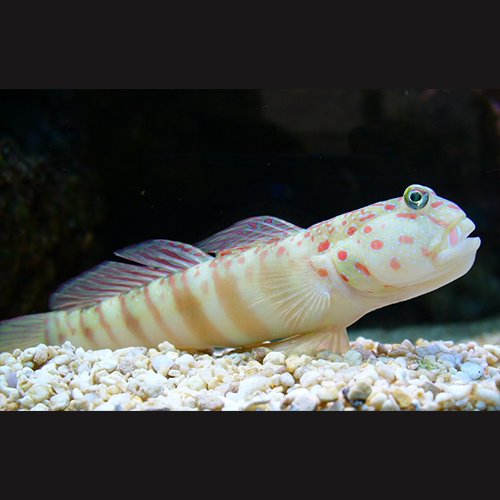
Pink-speckled Shrimpgoby (Cryptocentrus leptocephalus)
Overview
Cryptocentrus leptocephalus, widely known as the Pink-Speckled Shrimp Goby or Leptocephalus Goby, is a highly desirable species for marine aquarists interested in observing fascinating symbiotic relationships. It is well-regarded for its relatively peaceful demeanor and its distinctive, subtle coloration.
- Temperament: Peaceful and shy.
- Size: Grows to approximately 10–12 cm.
- Key Trait: Obligate relationship with alpheid (pistol) shrimp. In the wild and in captivity, the goby and shrimp share a burrow; the shrimp excavates and maintains the burrow, while the goby provides a lookout, warning the shrimp of approaching danger.
- Behavior: Primarily bottom-dwelling; they spend much of their time at the burrow entrance, resting on the sand or rock.
Care Requirements
- Tank Size: Minimum 20–30 gallons.
- Environment: Requires a fine-grained sand bed (at least 2–3 inches deep) to allow for burrowing. Providing both sand and some small rubble pieces helps the pistol shrimp construct a stable tunnel.
- Lid: As with most gobies, a tight-fitting lid is mandatory to prevent jumping.
- Water Parameters:
- Temperature: 22–26°C.
- Salinity: 1.020–1.025 SG.
- pH: 8.1–8.4.
Maintenance
- Water Quality: Standard reef parameters. They are moderately hardy but appreciate stable conditions.
- Routine: Regular water changes (10–20% biweekly) and good mechanical/biological filtration.
- Tank Setup: Ensure rockwork is placed directly on the bottom glass, as the shrimp and goby will dig under structures, which can cause unsecured rocks to collapse.
Diet
- Type: Carnivore/Planktivore.
- Staples: In the aquarium, they accept high-quality frozen foods like Mysis shrimp, brine shrimp, and finely chopped marine seafood. They will also take high-quality sinking pellets.
- Feeding Habits: They are not aggressive feeders and may be outcompeted by faster fish. If kept with fast-swimming tankmates, use target feeding or a feeding tube to deliver food near the burrow entrance.
Behavior and Compatibility
- Tankmates: Peaceful toward other fish. Ideal tankmates are small, non-aggressive species like clownfish, firefish, or small blennies.
- Avoid: Do not house with aggressive, fast-moving fish or bottom-dwellers (like other gobies or blennies) that may harass them or compete for the same burrow territory.
- Symbiosis: To see their most natural, active behavior, pair them with a compatible pistol shrimp (such as Alpheus randalli or Alpheus bellulus).
Reproduction
- They form pairs and can spawn in home aquaria. The eggs are typically laid inside the burrow.
- Captivity: Rearing the fry is extremely challenging, requiring a dedicated larval tank and an abundance of microscopic, live planktonic food, making it an advanced project.
Tips
- The “Shrimp Partnership”: If you keep this goby without a pistol shrimp, it may become more reclusive and spend more time hiding in the rockwork rather than the sand bed.
- Feeding: Ensure they are eating well during the first few days of introduction, as they can be shy in a new environment.
- Sand Quality: Use fine sand to allow the shrimp to build the burrow efficiently.
Picture for illustrative purposes only. Either come in store to view available stock or request pictures to be sent to you.
Please Note: Due to variations within species resulting from age, region, sex, etc., the actual livestock may not look identical to the image. Approximate size range may also vary between individual specimens.